


Research News
Waste Management in Spider Mites Reveals Evolutionary Insights into Arthropod Social Behavior
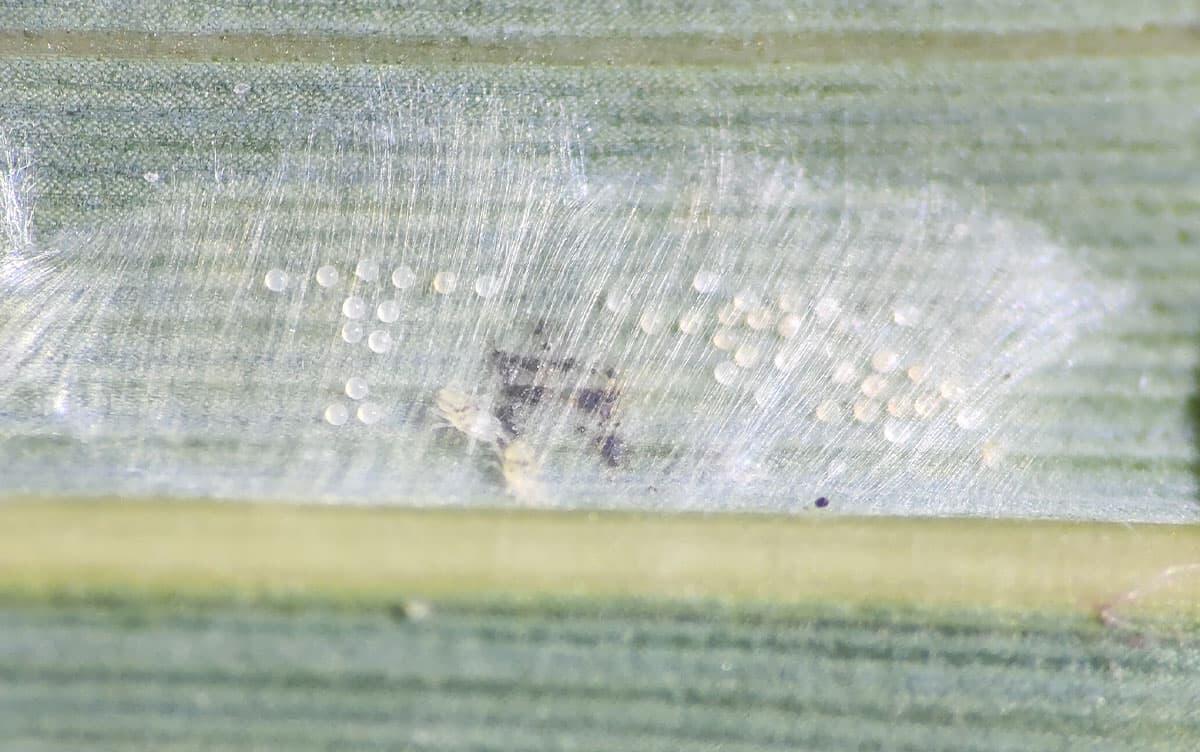
Researchers at University of Tsukuba have discovered the adaptive significance of the remarkable waste-management behavior in the social spider mite Stigmaeopsis longus, a tiny herbivorous arthropod that lives in cooperative groups. These mites protect their eggs from the adverse effects of fecal accumulation by defecating in designated areas near the nest entrance. This study is the first to experimentally demonstrate the adaptive function of excretory behavior in a social spider mite, offering new insights into the evolution of sociality and nest-based living in arthropods.
Tsukuba, Japan—Effective waste management is essential for group-living organisms to prevent disease and maintain hygienic nest environments. Despite its importance, few studies have experimentally verified how the sanitation behavior of these organisms affects their survival and reproduction.
Individuals of Stigmaeopsis longus—a subsocial species in which parents and offspring cohabit—exhibit a unique "communal toilet" behavior, defecating only in specific zones near the nest's entrances and exits. In this study, researchers investigated the adaptive significance of this behavior by manipulating the location and number of defecation sites using chemical cues extracted from the leaves of Sasa veitchii, one of the mite's host plants. Subsequently, they compared reproductive success and survival across female populations at medium and high nest-founding-female densities.
The results showed that relocating defecation sites from the nest edge to the center did not significantly affect adult or larval survival but slightly reduced egg survival under high-density conditions. Additionally, altering defecation patterns led to increased nest extension across all density levels. Crucially, when nest entrances and exits were physically blocked, preventing nest extension, egg survival declined significantly even under medium-density conditions. These findings suggest that spatial control of waste is particularly vital for the survival of immobile life stages such as eggs.
This study provides the first empirical evidence that waste-management behavior plays an adaptive role in social spider mites. Moreover, it represents a major step toward understanding how sanitation behaviors contribute to the evolution of sociality and nest-building in arthropods.
###
This research was supported in part by the Suzuki Takahisa Memorial Grant, the University of Tsukuba (to YS).
Original Paper
- Title of original paper:
- The Adaptive Function of Waste Management in a Social Spider Mite
- Journal:
- Biology Letters
- DOI:
- 10.1098/rsbl.2025.0397
Correspondence
Associate Professor SATO Yukie
Institute of Life and Environmental Sciences / Mountain Science Center, University of Tsukuba
SHINDO Keita
Master's Program in Biology, Degree Programs in Life and Earth Sciences, Graduate School of Science and Technology, University of Tsukuba
Related Link
Institute of Life and Environmental Sciences
Mountain Science Center
