


Research News
Discovery of the Most Intron-Rich Eukaryotic Genome
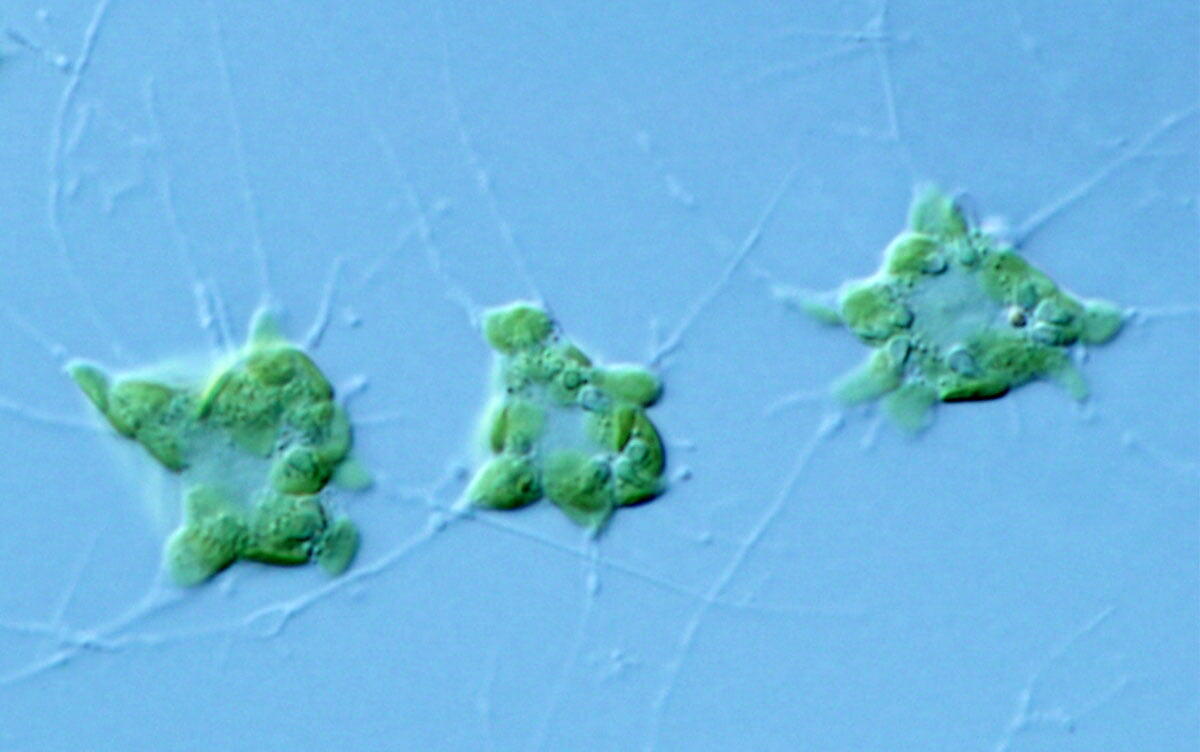 Provided by Yoshihisa Hirakawa
Researchers at University of Tsukuba have decoded the nuclear genome of Amorphochlora amoebiformis, a unicellular marine alga belonging to the chlorarachniophyte group. The genome is approximately 214 megabase pairs in size and contains around 17,500 protein-coding genes. Notably, introns (noncoding sequences typically removed by splicing) constitute approximately three-quarters of the genome, making it the most intron-rich eukaryotic genome reported to date.
Tsukuba, Japan—The advent of next-generation sequencing technologies has accelerated genome analysis across diverse eukaryotic lineages. In particular, long-read sequencing facilitates the assembly of large, complex genomes containing a high proportion of repetitive elements.
In this study, researchers used long-read sequencing to decode the nuclear genome of Amorphochlora amoebiformis, revealing an approximate length of 214 million base pairs that encodes about 17,500 proteins, with introns accounting for 74% of the genome sequence. Compared with other eukaryotic genomes, the proportion of introns is extremely high. Since a closely related chlorarachniophyte species, Bigelowiella natans, has an intron content of around 30%, the extensive intron gains observed in the nuclear genome of A. amoebiformis are inferred to have occurred independently during its evolution. Although the reason for this increase remains unknown, this study provides important insights into the evolutionary dynamics and potential functional roles of introns in eukaryotic genomes.
###
This work was funded by the Japan Society for the Promotion of Science (JSPS) KAKENHI Grant Numbers 21K06285 and 25K02093, the Institute for Fermentation, Osaka (LA-2022-011), and the Sasakawa Scientific Research Grant from the Japan Science Society (2023-5024).
Original Paper
- Title of original paper:
- Nuclear genome sequencing reveals the highly intron-rich architecture of the chlorarachniophyte alga Amorphochlora amoebiformis
- Journal:
- DNA Research
- DOI:
- 10.1093/dnares/dsaf035
Correspondence
Assistant Professor HIRAKAWA Yoshihisa
Institute of Life and Environmental Sciences, University of Tsukuba
Related Link
Institute of Life and Environmental Sciences


