


Research News
Expansion of the Chinese Hwamei, an Invasive Alien Species, into Alpine Habitats in Japan: First Record of Songs
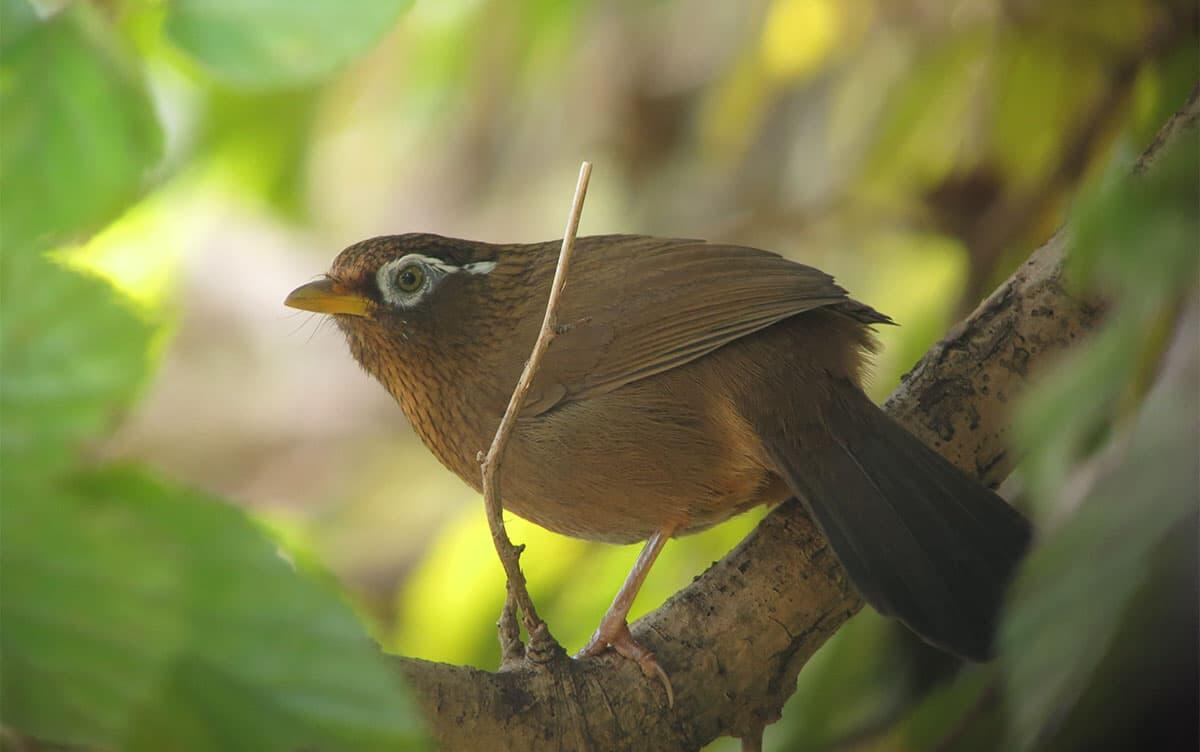 (C)IIJIMA Daichi
Researchers at University of Tsukuba have, for the first time, recorded the songs of the Chinese hwamei Garrulax canorus (designated as an invasive alien species) in the alpine zone of Mt. Kisokoma in the Central Alps (approximately 2,770 m above sea level). These songs, produced by males during the breeding season, serve to establish territories and attract females. This finding raises concerns that the breeding range of Chinese Hwamei may be expanding from lowland habitats into the alpine zone.
Tsukuba, Japan—The Chinese hwamei, an invasive alien bird species, is native to eastern Eurasia, ranging from southern China to Southeast Asia. In Japan, the species had been brought to Japan as a pet birds since the Edo period. Since the first field records in Kitakyushu City during the 1980s, its distribution has expanded steadily. In 2024, it was formally designated as an invasive alien species owing to its potential ecological impacts. Its expansion in Japan was largely restricted to lowland regions, but observations in recent years indicate that it has begun to colonize the mountainous regions. However, no previous records existed from alpine zones above the treeline.
On August 6, 2024, members of the research team recorded songs of Chinese hwamei in Japanese stone pine scrub at 2,770 m above sea level (a.s.l.) on Mt. Kisokoma. On September 10, 2024, songs were confirmed in the forest north of the Shirabidaira Station on the Komagatake Ropeway (approximately 1,700 m a.s.l.). On October 18, 2024, they were documented in the forest surrounding the Ikeyama Hut (approximately 1,750 m a.s.l.) on Mt. Kisokoma.
Traditionally, high-elevation areas with heavy snow cover were considered an unsuitable habitat for the Chinese hwamei. However, contemporary studies in Japan suggest that some individuals breed in mountainous regions during summer and migrate to areas with reduced snow cover in winter. The present study indicates that the Chinese hwamei, which exhibits seasonal altitudinal migration, has begun to use alpine zones during the breeding season. Because songs are typically produced by males to assert territory and attract mates, these observations underscore the need for continued monitoring in alpine and subalpine zones to evaluate the potential impact of Chinese Hwamei on native alpine bird communities.
###
This work was supported by the Japan Society for the Promotion of Science (JSPS) through Grants-in-Aid for Scientific Research 23KJ1792.
Original Paper
- Title of original paper:
- Record of songs of the invasive alien bird species, Chinese Hwamei Garrulax canorus, during the breeding season in the alpine zone of Mount Kisokoma, central Japan
- Journal:
- Bird Research
- DOI:
- 10.11211/birdresearch.21.S6
Correspondence
Associate Professor IIJIMA Daichi
Institute of Life and Environmental Sciences, University of Tsukuba
Researcher MIZUMURA Haruka
Division of Natural & Human Environmental Science, Mount Fuji Research Institute, Yamanashi Prefectural Government.
Research Officer KOBAYASHI Atsushi
Natural Environment Division, Nagano Environmental Conservation Research Institute
Related Link
Institute of Life and Environmental Sciences

