


Research News
Genome Editing Turns Red Lettuce Green and Increases Beneficial Flavonoid Content
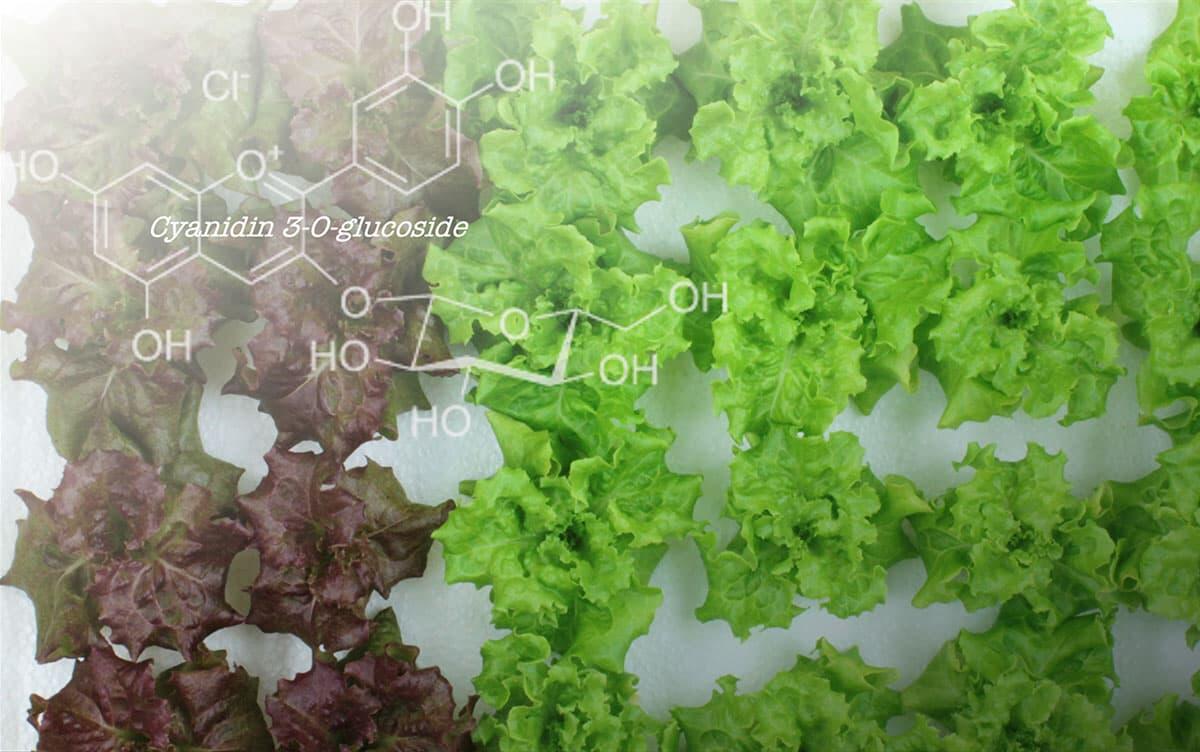 provided by Hiroshi Ezura
The red coloration of red-leaf lettuce is attributable to anthocyanins. Researchers at University of Tsukuba showed that targeted knockout of genes encoding enzymes involved in anthocyanin biosynthesis, achieved through genome editing, eliminates red pigmentation without causing detectable effects on plant growth. They further demonstrated that this modification increase levels of other flavonoids, including quercetin.
Tsukuba, Japan—Red-leaf lettuce is red owing to anthocyanins, a class of polyphenolic pigments widely studied for their antioxidant properties. In plants, anthocyanins are synthesized through enzymatic reactions originating from the amino acid phenylalanine. Along this biosynthetic pathway, multiple flavonoids—an umbrella term for diverse plant secondary metabolites—are produced as intermediates and ultimately converted into anthocyanins.
In this study, the researchers used genome editing to inactivate the gene encoding dihydroflavonol 4-reductase, which catalyzes a key step immediately upstream of anthocyanin production in red lettuce. Disruption of this gene eliminated red pigmentation. Metabolite analyses also revealed increased accumulation of other flavonoids, including quercetin, indicating a redirection of metabolic flux within the flavonoid biosynthesis pathway.
Notably, no significant negative effects on lettuce growth were observed following this genetic modification, highlighting the potential to control flavonoid composition by favoring precursor accumulation rather than anthocyanin production while maintaining normal growth and yield. Although direct comparisons with green lettuce cultivars remain to be performed, red lettuce is known to exhibit high polyphenol biosynthetic activity. Therefore, the researchers' approach represents a promising strategy for developing lettuce cultivars with tailored functional components. Moreover, because flavonoid biosynthesis is strongly influenced by environmental factors such as light intensity and temperature, these findings may support the establishment of functional lettuce varieties optimized for plant factories, where growth conditions can be precisely controlled.
###
The research in the Ezura group is funded by the following grants: Program on Open Innovation Platform with Enterprises, Research Institute and Academia, Japan Science and Technology Agency (JSTOPERA, JPMJOP1851).
Original Paper
- Title of original paper:
- CRISPR/Cas9-mediated knockout of DFR alters pigmentation and shifts flavonoid accumulation in red leaf lettuce without detectable growth penalties
- Journal:
- Frontiers in Genome Editing
- DOI:
- 10.3389/fgeed.2026.1755922
Correspondence
Specially Appointed Professor EZURA Hiroshi
Institute of Life and Environmental Sciences, University of Tsukuba
Professor GOTO Eiji
Graduate School of Horticulture, Chiba University
Related Link
Institute of Life and Environmental Sciences


