


Research News
Parasite Emergence Facilitated by Host Wing-Raising Behavior
 Provided by Natsuho Ishikawa
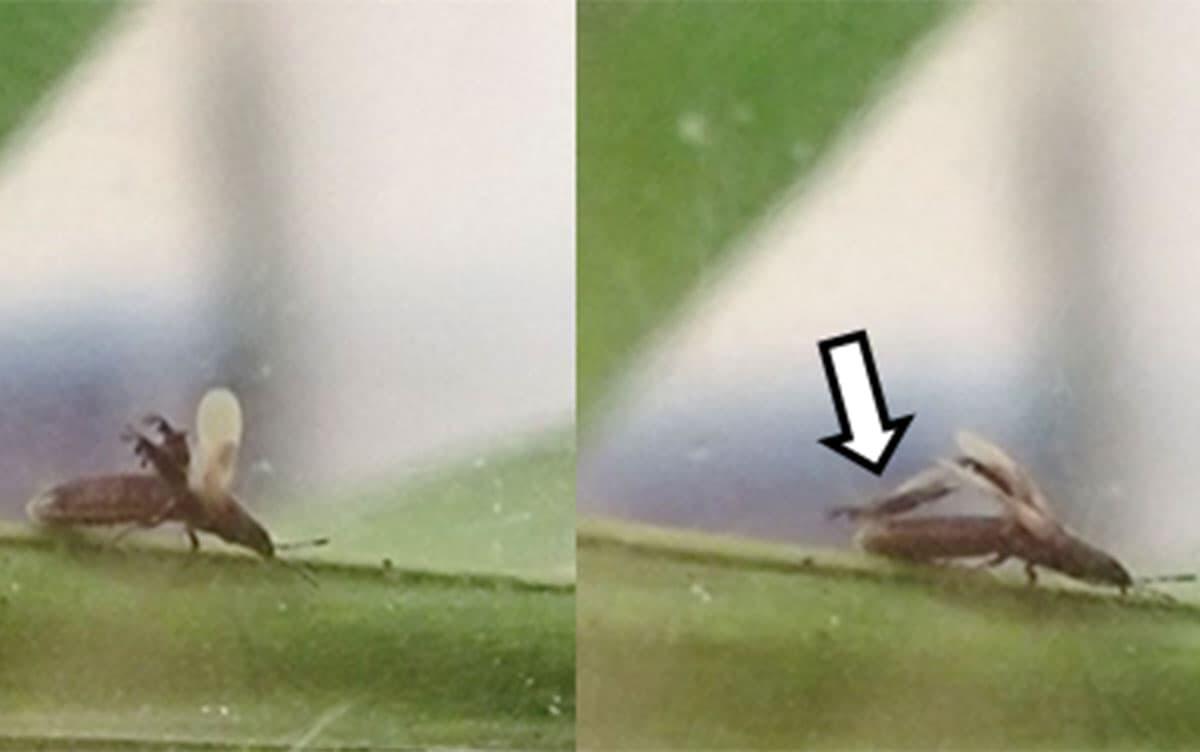
Male strepsipterans develop inside a host insect during their larval stage and, upon reaching the adult stage, emerge from the host body to begin a free-living phase. In this study, researchers at University of Tsukuba directly observed the emergence behavior of male strepsipterans parasitizing stink bugs, where emergence sites are concealed beneath the host's wings, and found that, during emergence, the host exhibits a characteristic wing-raising behavior.
Tsukuba, Japan—All species of the order Strepsiptera are endoparasitic insects that invade hosts, including hornets, planthoppers, and stink bugs, during the first-instar larval stage and develop within the host body. While adult females remain permanently within the host, adult males emerge after eclosion and actively seek females for mating. Male emergence from hosts has previously been documented in only three strepsipteran families, all emerging from externally exposed sites of the host body, such as the posterior abdomen in hornets or planthoppers. In contrast, in the family Corioxenidae, which parasitizes stink bugs, the male emergence site lies on the dorsal abdomen beneath the host's wings, suggesting that the wings may obstruct emergence. Although this anatomical constraint has long been recognized, direct observations of male emergence in this group have not been reported.
In this study, the researchers observed male emergence in Blissoxenos esakii (Strepsiptera: Corioxenidae), a parasite of the stink bug Macropes obnubilus (Hemiptera: Blissidae). During emergence, the host raised its wings, a behavior not observed in unparasitized individuals. This wing-raising temporarily exposed the concealed emergence site, allowing the male parasite to exit the host body.
These results reveal a previously unrecognized strategy employed by corioxenid parasites to overcome host-imposed morphological barriers. The findings advance our understanding of host range diversification within Strepsiptera and provide insight into how host-utilization strategies have specialized across lineages.
Original Paper
- Title of original paper:
- Host wing-raising behavior enables emergence of Blissoxenos esakii (Strepsiptera: Corioxenidae) from a site covered by the wings
- Journal:
- Entomological Science
- DOI:
- 10.1111/ens.70015
Correspondence
ISHIKAWA Natsuho
Laboratory of Applied Entomology and Zoology, College of Biological Sciences, University of Tsukuba
Assistant Professor KURAMITSU Kazumu
Institute of Life and Environmental Sciences, University of Tsukuba
Related Link
Institute of Life and Environmental Sciences
