


Research News
Intensification of Atmospheric Rivers Bringing Heavy Rainfall to Japan
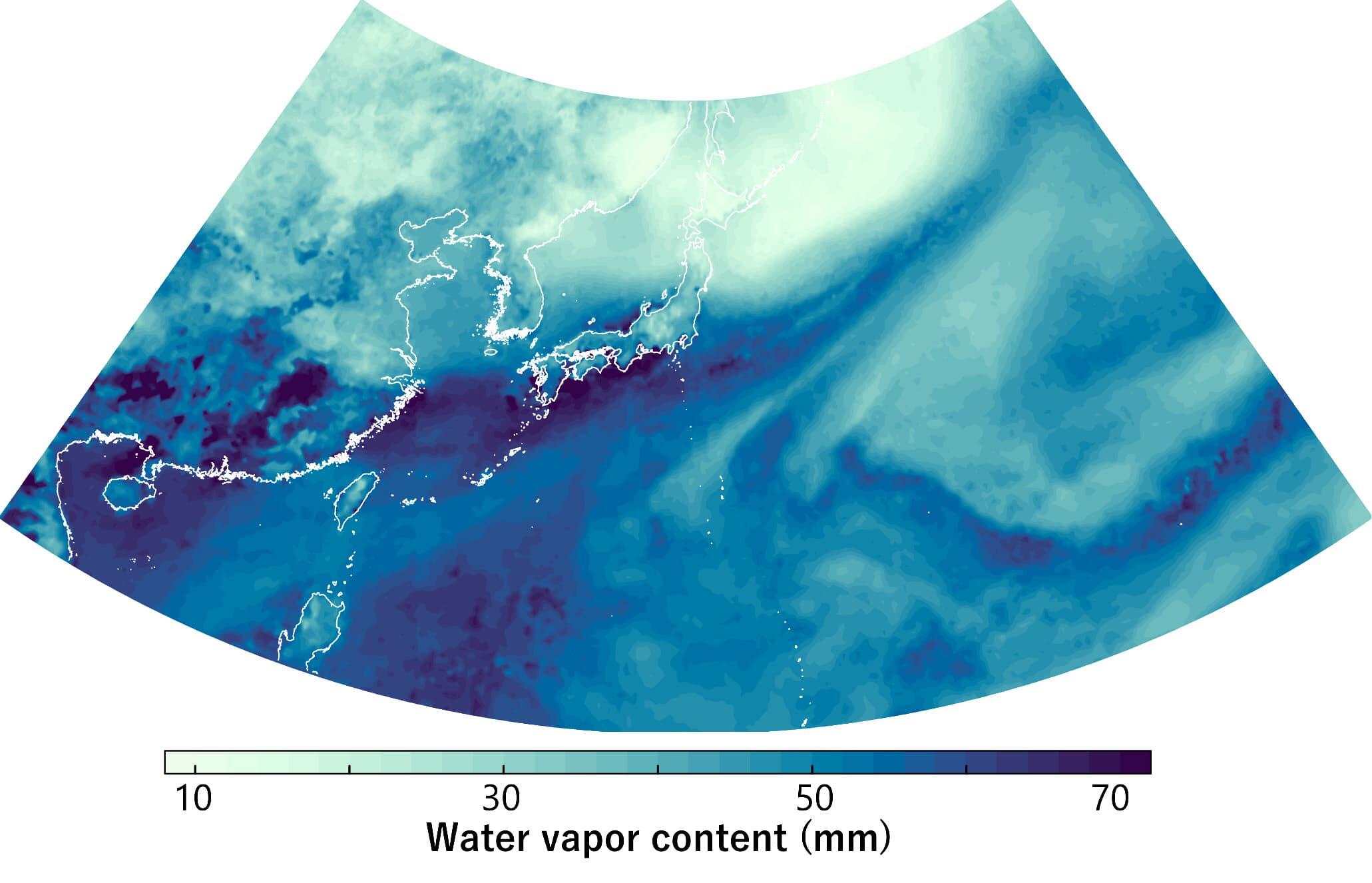
Atmospheric rivers (ARs) are long, narrow bands of intense water vapor transport that move large amounts of moisture from low to mid latitudes, resembling giant rivers in the sky. They are gaining widespread attention because of their potential to trigger flooding across the Japanese archipelago. Researchers at University of Tsukuba have discovered that influenced by global warming and the strengthening of the North Pacific Subtropical High, the intensity of water vapor transport in ARs has increased by approximately 8% over the past 42 years (1981-2022).
Tsukuba, Japan—In East Asia, including Japan, atmospheric rivers transport substantial amounts of water vapor in the lower to mid-troposphere, facilitating the development of widespread precipitation systems. These systems can produce elongated rainbands, often termed linear precipitation systems, and lead to severe flooding. Although heavy rainfall associated with ARs has recently become more frequent, the long-term changes in AR intensity have remained unclear.
Herein, researchers employed a machine learning technique called self-organizing maps to classify daily sea-level pressure patterns around Japan during midsummer. ARs are more likely to form when the North Pacific Subtropical High extends westward over the ocean south of Japan. Under these conditions, southwesterly winds along the northwestern flank of the high enhance moisture transport.
Consequently, the intensity of AR-related water vapor transport over western and eastern Japan has increased by approximately 8.3% over the past 42 years. This increase aligns with the increase in atmospheric water vapor content linked to global warming. In addition, strengthening low-level winds associated with the intensification of the subtropical high have further boosted moisture transport. Overall, the findings indicate that atmospheric rivers (ARs) have intensified, specifically in recent decades.
Previous work by these researchers has shown that ongoing global warming is likely to increase the intensity of ARs over the Japanese archipelago during summer, resulting in more frequent extreme rainfall events. The current findings suggest that this projected trend has already begun to materialize over the past 4 decades.
###
This work was supported by JSPS KAKENHI Grant Numbers JP25K07396, JP25H00687, JP24H02228, and the Advanced Studies of Climate Change Projection (SENTAN, JPMXD0722680395 and JPMXD0722680734), and the Arctic Challenge for Sustainability (ArCSIII, JPMXD1720251001) Project of the Ministry of Education, Culture, Sports, Science, and Technology of Japan.
Original Paper
- Title of original paper:
- Increased water vapor transports of atmospheric rivers around the western flank of the North Pacific High since the 1980s
- Journal:
- Climate Dynamics
- DOI:
- 10.1007/s00382-026-08189-x
Correspondence
Associate Professor KAMAE Yoichi
Institute of Life and Environmental Sciences, University of Tsukuba
Professor SATO Tomonori
Faculty of Environmental Earth Science, Hokkaido University
Related Link
Institute of Life and Environmental Sciences
