


Research News
A Genetic Toolkit Uncovers the Roles of Capsular Polysaccharides in the Human Gut Bacterium Mediterraneibacter gnavus
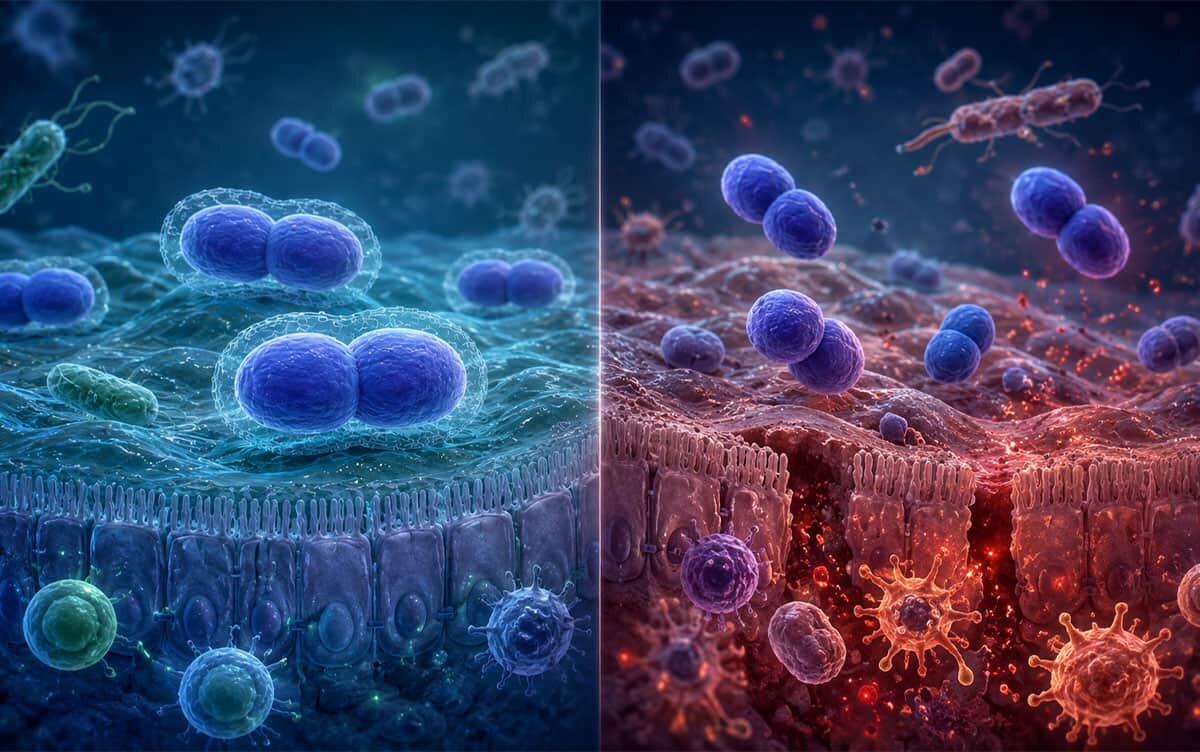 image created by ChatGPT
Researchers at University of Tsukuba have developed genetic manipulation tools to characterize the human gut bacterium Mediterraneibacter gnavus, which has been associated with inflammatory bowel disease, allergies, and other diseases. Using these tools, they demonstrated that capsular polysaccharides (CPS), which cover the bacterial surface, are critical for intestinal colonization and are associated with inflammatory activity.
Tsukuba, Japan—The human gut harbors more than 40 trillion bacteria that are assembled into complex communities known collectively as the gut microbiota, which are closely linked to human health and disease. Mediterraneibacter gnavus (formerly Ruminococcus gnavus) is a commensal bacterium of the family Lachnospiraceae that is normally found in healthy individuals. However, it is frequently enriched in patients with inflammatory bowel diseases (such as Crohn's disease), and its abundance has been correlated with disease severity. Despite the clinical relevance of M. gnavus, the molecular mechanisms underlying its intestinal colonization and strain-dependent effects on host inflammation remain poorly understood, largely because this bacterium presents technical challenges for genetic manipulation.
In this study, researchers developed a suite of molecular genetic tools specifically for characterizing M. gnavus, including an E. coli-M. gnavus shuttle vector, inducible gene expression systems, fluorescent reporters, and systems for gene disruption and deletion. Notably, these tools were applicable not only to M. gnavus but also to other common human commensals in the Lachnospiraceae family.
Researchers identified a gene cluster responsible for CPS biosynthesis and demonstrated the importance of CPS production in competitive intestinal colonization, as demonstrated in germ-free mouse models. CPS forms a protective layer on the bacterial surface and participates in host-microbe interactions. Notably, CPS production was inversely correlated with inflammatory activity. Mutant strains lacking CPS induced stronger inflammatory responses, whereas mice colonized with CPS-deficient strains exhibited more severe inflammation. Comparative genomic analyses further revealed that CPS-related gene clusters tend to occur more frequently in strains isolated from healthy individuals than in those isolated from patients with Crohn's disease.
This study establishes a platform for the functional analysis of gut bacteria that present difficulties for genetic manipulation. The findings advance our understanding of the influence of specific bacterial genes on host-microbe interactions. Furthermore, the results may help elucidate the mechanisms underlying inflammatory diseases and facilitate the development of next-generation probiotic microbes that promote intestinal homeostasis.
###
This work is supported by the Japan Society for the Promotion of Science (JSPS) KAKENHI Grant Number 25K01926 (N.O.), Institute for Fermentation, Osaka (IFO) (N.O.), JSPS KAKENHI Grant Number 23H05471 (N.N.), Japan Science and Technology Agency (JST) ERATO Grant Number JPMJER1902 (S.F.), and Food Science Institute Foundation (S.F.).
Original Paper
- Title of original paper:
- A genetic toolkit for the human gut bacterium Mediterraneibacter gnavus identifies capsular polysaccharides as a competitive colonization factor
- Journal:
- Nature Communications
- DOI:
- 10.1038/s41467-026-69022-x
Correspondence
Assistant Professor OBANA Nozomu
Institute of Medicine, University of Tsukuba
Visiting Professor FUKUDA Shinji
Institute of Medicine, University of Tsukuba (Specially Appointed Professor/Institute for Advanced Biosciences, Keio University, Specially Appointed Professor/Innovative Microbiome Therapy Research Center, Juntendo University Graduate School of Medicine)
Related Link


