


Research News
Functional NIN Persists in Non-Nodulating Plants: Rethinking the Loss of Symbiosis
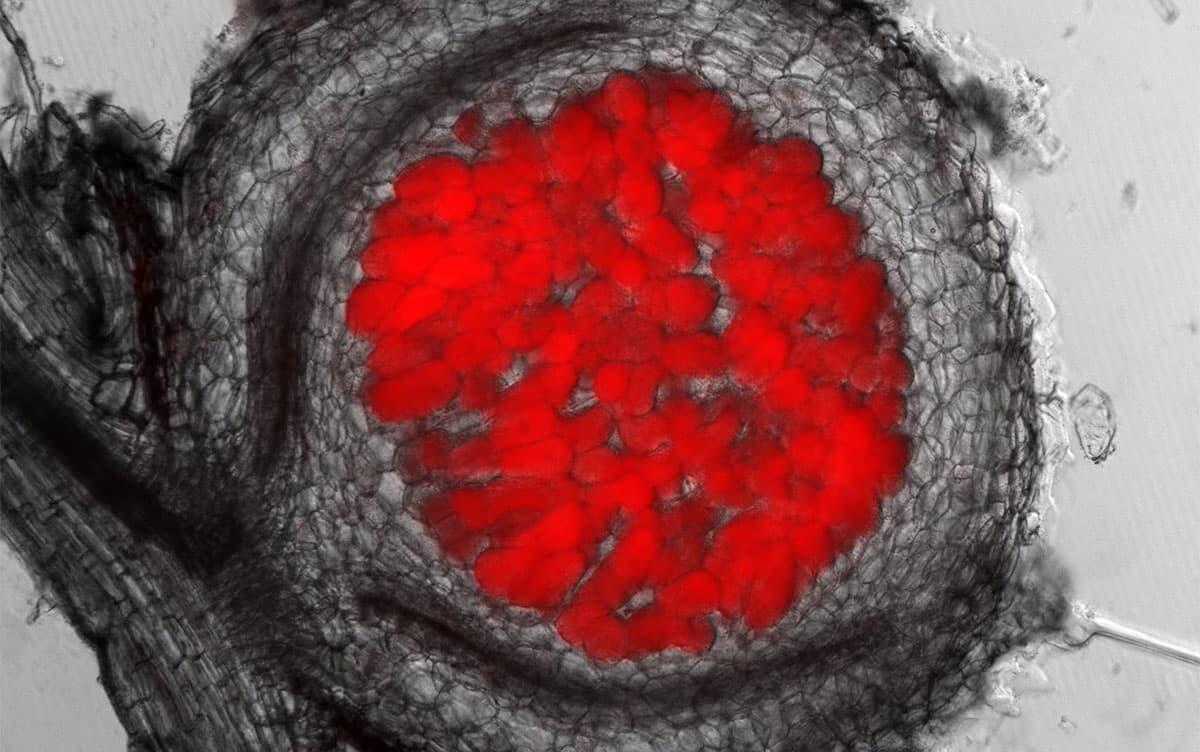
Researchers at University of Tsukuba have shown that, in the taxonomic order Fagales, the master transcription factor NODULE INCEPTION (NIN), which regulates root nodule symbiosis, remains functional even in plants lacking nodule formation. This finding indicates that the loss of nodulation is not necessarily linked to the loss of the NIN gene, providing new insight into the evolutionary mechanisms underlying root nodule symbiosis.
Tsukuba, Japan—Certain plants, including legumes, form specialized root organs known as nodules. These plants establish symbiotic relationships with nitrogen-fixing bacteria and utilize atmospheric nitrogen. This process, termed as "root nodule symbiosis," is an important biological function that can reduce reliance on chemical nitrogen fertilizers. At the genetic level, previous studies, primarily on legumes, have demonstrated that the transcription factor NODULE INCEPTION (NIN) is essential for root nodule symbiosis. This finding has led to the prevailing view that the loss of the NIN gene is primary responsible for nodulation loss.
Therefore, in this study, the researchers investigated the evolution and function of the NIN gene in Fagales species. Their analyses revealed that a functional NIN gene is conserved in species that no longer form root nodules.
The researchers first isolated NIN orthologs from the non-nodulating Fagales species European hazel (Corylus avellana). Subsequently, the genes were introduced into a Lotus japonicus nin mutant lacking nodule formation. The results showed that C. avellana NIN restored key symbiotic functions in the mutant, including nodule organogenesis, rhizobial infection, and the formation of mature nitrogen-fixing nodules. These findings demonstrate that even in non-nodulating plants, the NIN protein retains its capacity to regulate root nodule symbiosis. Furthermore, comparative genomic analyses suggest that nodulation loss in non-nodulating Fagales species may be associated with the loss or disruption of other symbiosis-related genes, such as RHIZOBIUM-DIRECTED POLAR GROWTH, rather than NIN.
This study challenges the conventional view that the loss of NIN is the primary driver of nodulation loss and provides new insights into the molecular basis and evolution of root nodule symbiosis. This finding advances our understanding of plant-microbe co-evolution and may contribute to the development of sustainable agricultural technologies to reduce dependence on chemical nitrogen fertilizers.
###
This research was supported by MEXT/JSPS KAKENHI (grant nos. JP23K27188, JP25H01345, and JP26K02024), JST ALCA-Next (JPMJAN23D2), JST SPRING (JPMJSP2124), and the Cooperative Research Grant of the Plant Transgenic Design Initiative by Tsukuba-Plant Innovation Research Center, University of Tsukuba (#2536).
Original Paper
- Title of original paper:
- Nonnodulating Fagales retain the functional NODULE INCEPTION gene
- Journal:
- New Phytologist
- DOI:
- 10.1111/nph.71337
Correspondence
Professor SUZAKI Takuya
Institute of Life and Environmental Sciences, University of Tsukuba
Related Link
Institute of Life and Environmental Sciences


