


Research News
Hidden Molecular Instructions: Overlooked Tosyl Groups Guide Shape-Shifting Pillararenes
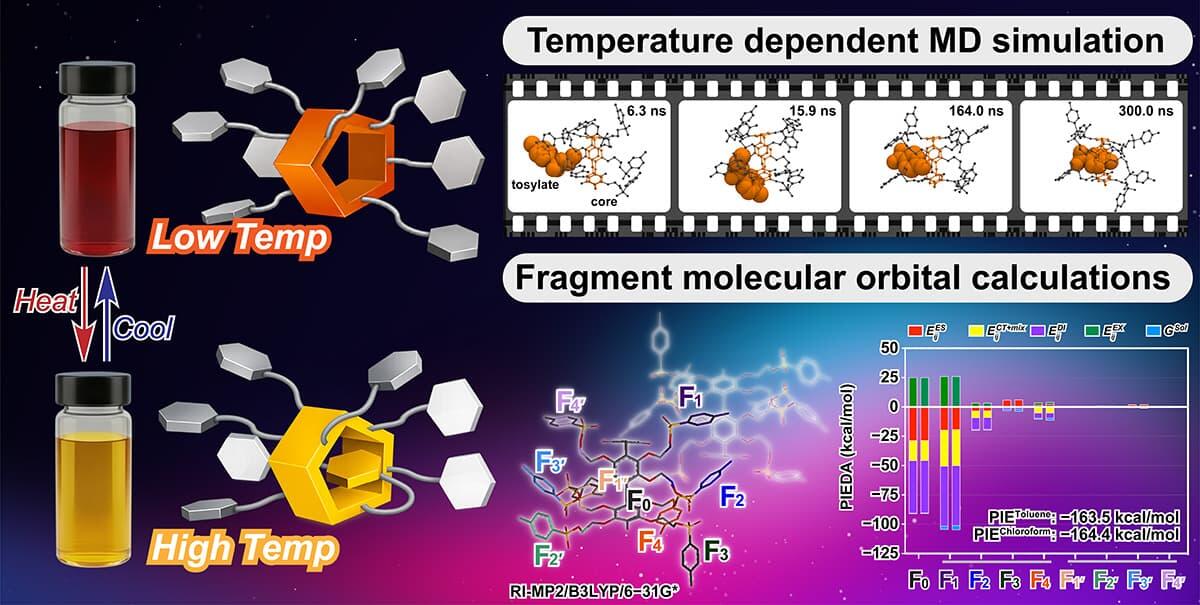
Researcher team reveal that a routine synthetic group can act as a supramolecular "instruction code," directing molecular organization and enabling temperature-responsive color changes.
A research team at Mahidol University, Thailand has discovered that tosyl groups, long regarded as routine synthetic handles, can actively guide the formation and behavior of pillararenes—a class of pillar&mdashshaped macrocyclic molecules widely used in supramolecular chemistry. Their findings reveal that these groups can act as a hidden "instruction code" that influences the organization of molecular components before bond formation and enables temperature-triggered switching accompanied by visible color changes.
Molecular dynamics simulations and fragment molecular orbital calculations reveal how a routine synthetic group acts as a built-in "instruction code," steering molecular assembly and enabling reversible, temperature-triggered color change.
Tsukuba, Japan—What if a molecule already knew how to build itself before a reaction even started? This is essentially what researchers at Mahidol University and Suranaree University of Technology in Thailand and University of Tsukuba in Japan have discovered about tosyl groups, sulfonate-based groups that are routinely removed after synthesis, that generations of chemists have rarely considered if they carry any deep structural information.
It turns out they do. This study shows that tosyl groups can act as a form of molecular code: their distinctive capacity to engage in directional C-H···O and C-H···π interactions enables molecules bearing them to spontaneously preorganize into pseudorotaxane-like geometries before any covalent bond formation occurs. This results in an effectively biased outcome of subsequent macrocyclization reactions, steering the assembly toward a single, precise product out of eight statistically possible outcomes, without the need for an external template.
"Rather than acting as a passive synthetic handle," the researchers write, "the tosyl group serves as a supramolecular directing element."
This encoded behavior goes further. After ring closure, the number of tosyl groups determines higher-order assembly behavior, a concept the researchers describe as supramolecular valency. A single tosyl unit yields isolated rings, four promote dimer formation, and five drive the formation of extended interlocked polymeric chains. By contrast, brominated analogs lacking comparable directional code produce only statistical mixtures without defined higher-order organization.
Oxidation of the tetratosylated ring introduces a benzoquinone unit that adds functional responsiveness to the encoded behavior: the molecule behaves as a thermally driven topology switch, reversibly toggling between an interpenetrated dimer at low temperatures and a self-included monomer at high temperatures. This transition is accompanied by a visible color change from red to yellow, which can be quantified using a smartphone camera. Molecular dynamics simulations confirmed the switching mechanism at atomic resolution, showing folding of a tosyl-bearing arm into its molecular cavity above 60°C.
Fragment molecular orbital calculations further confirmed that interaction energies scale with the number of tosyl groups, with tosyl-core interactions approaching the magnitude of the central aromatic framework itself. The researchers suggest these energetic signatures could, in principle, be computed before synthesis to predict and rationally design assembly behavior.
The broad implication is a quiet but significant shift in how chemists may approach molecular design: not by choosing building blocks and assuming substituents will cooperate, but by treating substituents themselves as programmable elements that encode hierarchy, selectivity, and function from the outset.
Published in the Journal of the American Chemical Society, DOI: 10.1021/jacs.6c03673
###
This research was supported by Mahidol University (Fundamental Fund, NSRF, grant FF-077/2568). D.J.H. was supported by the NSRF via the Program Management Unit for Human Resources & Institutional Development, Research and Innovation (Grant No. B39G690005). K.H. acknowledges JSPS KAKENHI (Grant Numbers 21H05269 and 24K20888).
Original Paper
- Title of original paper:
- Beyond Passive Substituents: Tosyl-Directed Self-Templation Enables Selective Pillar[4 + 1]arene Formation and Topology Switching
- Journal:
- Journal of the American Chemical Society
- DOI:
- 10.1021/jacs.6c03673
Correspondence
Assistant Professor HENGPHASATPORN Kowit
Center for Computational Sciences, University of Tsukuba
Professor SHIGETA Yasuteru
Center for Computational Sciences, University of Tsukuba
Related Link
Center for Computational Sciences