


Research News
Isotopic Signatures Link Hot Spring Magmatic Water to the Subducting Pacific Plate
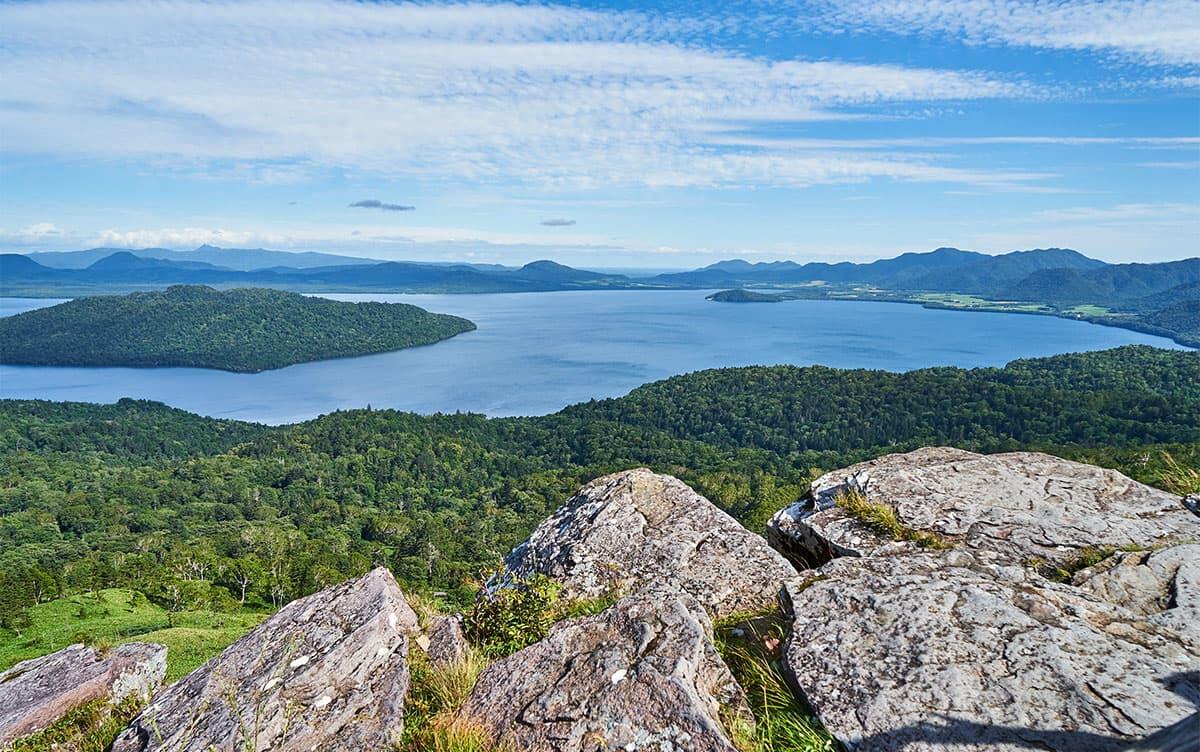 Image by osap/Shutterstock
Water flowing from hot springs near volcanoes often contains a mixture of meteoric water that has percolated underground and a deeper component known as magmatic water. Researchers at University of Tsukuba used numerical simulations and isotopic data to show that magmatic water in hot springs and volcanic gases around Kussharo Caldera, Hokkaido, originates from the subducting Pacific Plate, which descends from the Kuril Trench to a depth of about 125 km.
Tsukuba, Japan—Hot spring waters in volcanic regions are usually dominated by meteoric water that has infiltrated underground and been heated by magma. However, such waters may also contain magmatic water. Although magmatic water is generally thought to originate from subducting oceanic plates, direct evidence for this connection has been limited. To address this gap, the researchers focused on Kawayu Onsen in the Kussharo Caldera, Hokkaido.
First, they used numerical simulations to track how the isotopic composition of water changes during subduction. The simulations followed seawater trapped in oceanic crust, as well as water bound in clay and rock-forming minerals, and the results were compared with isotopic data reconstructed for magmatic water. The isotopic composition of magmatic water collected from Kawayu Onsen closely matched the simulated values for water released from the Pacific Plate at an approximate depth of 125 km beneath the caldera. This agreement provides strong evidence that the magmatic water originated from the Pacific Plate. The isotopic composition of magmatic water remained largely unchanged for interacting magma volumes of less than 2,000 km3. Furthermore, the researchers estimated the cumulative discharge of slab-derived water over the past 400,000 years to be at least 94.6 km3. In fumarolic gases from lava domes, however, isotopic values can shift because of vapor-liquid separation. After accounting for this process, previously published isotope data from fumarolic gases at Showa-Shinzan were reanalyzed, also supporting a Pacific Plate origin of the magmatic water.
Overall, these results offer new insights into how water moves through the deep Earth and how subducting plates can influence volcanic systems.
###
This work was supported by a Grant-in-Aid for Scientific Research (grant nos. 24K00169 & 24KJ0493) from Japan Society for the Promotion of Science.
Original Paper
- Title of original paper:
- Isotopic evidence for slab-derived magmatic water beneath the Kussharo Caldera, Japan.
- Journal:
- Journal of Volcanology and Geothermal Research
- DOI:
- 10.1016/j.jvolgeores.2026.108678
Correspondence
Professor YAMANAKA Tsutomu
Institute of Life and Environmental Sciences, University of Tsukuba
Related Link
Institute of Life and Environmental Sciences

