


Research News
A Fossil of a Small Dinosaur from Fukushima Prefecture Reveals Greater Diversity in Japan's Ancient Coastal Ecosystem
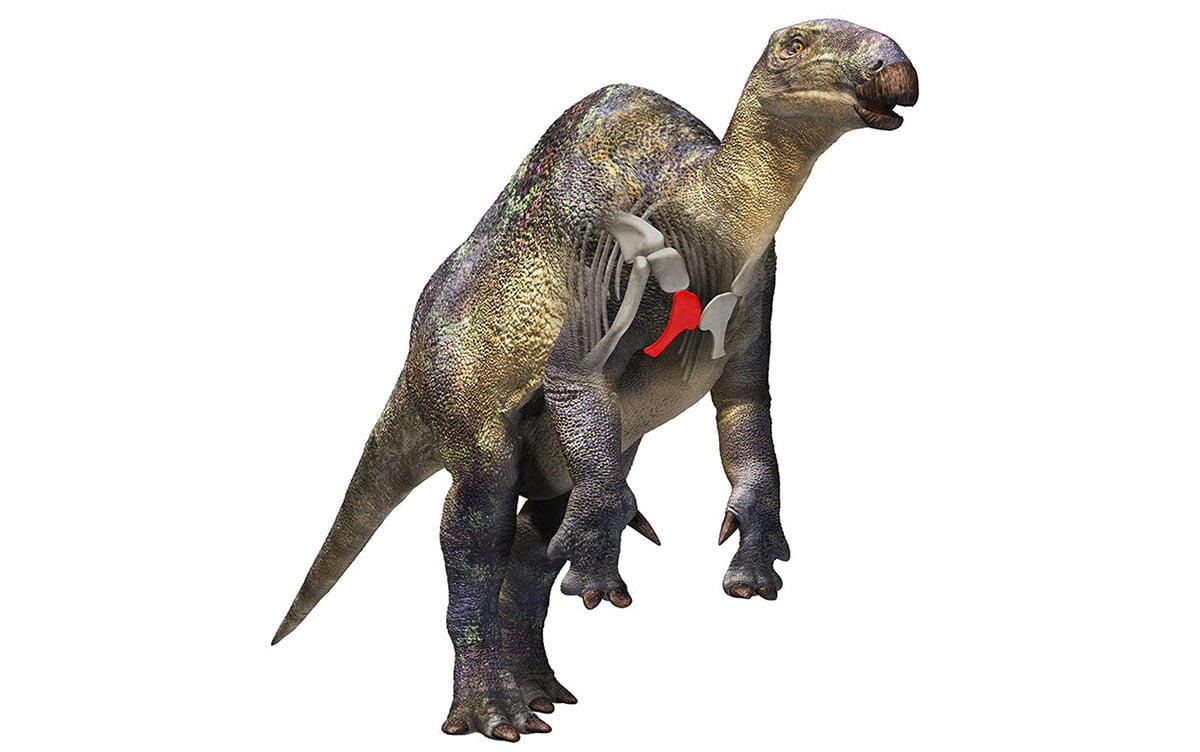 Image by Masato Hattori
A research group led by University of Tsukuba has examined a fossil in Iwaki City, Fukushima Prefecture, and identified it as the right sternal plate (part of the chest skeleton) of an iguanodontian dinosaur. The size of the sternal plate indicates that it belonged to a small individual with an estimated body length of approximately 3 meters. Since previously recovered iguanodontian specimens from the Upper Cretaceous in Japan appear to belong to larger individuals (exceeding 3 meters in body length), this discovery suggests that smaller iguanodontian individuals also inhabited coastal environments in East Asia.
Tsukuba, Japan—Iguanodontians are a diverse group of herbivorous dinosaurs that lived from the Late Jurassic to the Late Cretaceous and had a worldwide distribution. Intercontinental dispersal events between Asia, North America, and Europe played a key role in their diversification across Laurasia. Fossils discovered in Japan provide valuable insights into the evolution and biogeography of iguanodontians. Recent fossil discoveries in Japan have added to the evidence suggesting that these dinosaurs inhabited coastal environments along the eastern margin of Asia. However, while a nearly complete skeleton of a large iguanodontian (approximately 8 meters in length) has been reported, most iguanodontian fossils recovered from Japan are fragmentary, consisting of isolated teeth and other remains, leaving many aspects of their diversity and ecology poorly understood.
In 1999, an isolated bone fossil was discovered on the premises of the Iwaki City Ammonite Center in Fukushima Prefecture. The center is situated within the Obisagawa Member of the Ashizawa Formation (formed approximately 90-88 million years ago), specifically the lower part of the Upper Cretaceous Futaba Group, which represents a shallow-marine depositional environment. The specimen, tentatively identified as the sternal plate of a hadrosauroid dinosaur, remained unstudied for more than two decades.
This study provides a detailed morphological description of the specimen, identifying it as the right sternal plate of an indeterminate styracosternan (a derived iguanodontians that includes hadrosauroids). Comparison with related species estimates the animal's body length to be approximately 3 meters, which is significantly smaller than that of other iguanodontian fossils previously unearthed from the same formation. Because larger iguanodontians, including hadrosauroids, are known to have existed in Japan during the Late Cretaceous, the discovery suggests that iguanodontians of varying body sizes inhabited the coastal environments of East Asia. This finding provides new insights that further corroborate the diversity of ancient coastal ecosystems.
###
This study was supported by the Natural Sciences and Engineering Research Council of Canada Discovery Grant (RGPIN-04697).
Original Paper
- Title of original paper:
- An iguanodontian sternal plate from the Upper Cretaceous Ashizawa Formation (Futaba Group) of Fukushima Prefecture, Japan
- Journal:
- Paleontological Research
- DOI:
- 10.2517/prpsj.250042
Correspondence
Associate Professor TANAKA Kohei
Institute of Life and Environmental Sciences, University of Tsukuba
KONDO Masami
Graduate School of Science and Technology, University of Tsukuba
Curator YOSHIDA Junki
Fukushima Museum, Japan
Related Link
Institute of Life and Environmental Sciences
