


Research News
Polyubiquitin May Stabilize Tau Filament Structures in Neurodegenerative Diseases
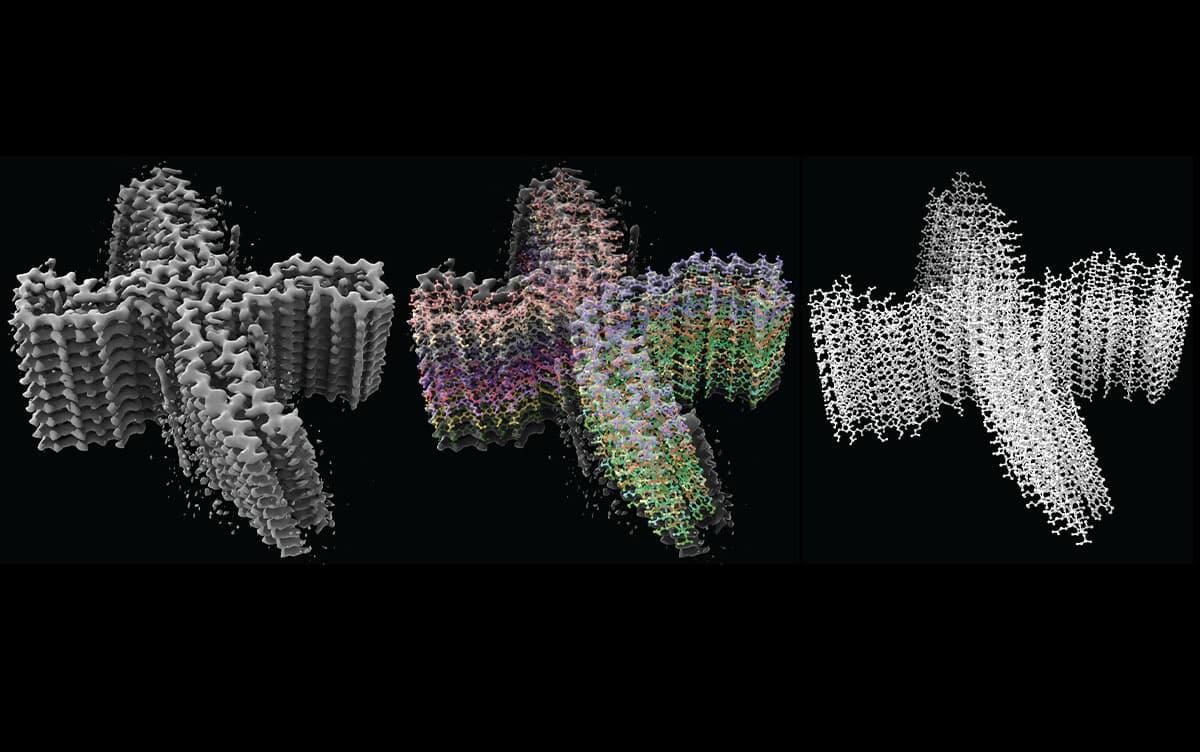 Structure of a pathological tau filament. (Structural data: PDB 10LN / EMDB EMD-75271)
Source: https://www.rcsb.org/structure/10LN
Understanding the mechanisms that stabilize distinct tau filament structures may help explain why tau-related neurodegenerative diseases develop different pathological features. A researcher now at the University of Tsukuba, together with colleagues at the University of Pennsylvania, analyzed the tau filaments that accumulate in the brains of patients with neurodegenerative diseases such as Alzheimer's disease. They found that, in certain tau filaments, repositioning the polyubiquitin attached to tau changes not only the surrounding molecular environment but also the filament core structure itself. The findings suggest that the spatial arrangement of post-translational modifications around the filament core helps stabilize disease-specific tau filament structures.
Tsukuba, Japan—In neurodegenerative diseases such as Alzheimer's disease, progressive neuronal damage is associated with the accumulation of abnormal tau filaments in the brain. The core of these tau filaments forms a highly ordered structure, while molecules such as ubiquitin are attached to tau around the core as post-translational modifications. However, the specific role that these peripheral modifications play in maintaining the structural stability of tau filaments remains unclear.
In this study, the researchers extracted tau filaments from the brain tissue of patients with Alzheimer's disease and vacuolar tauopathy, a rare inherited neurodegenerative disease. They examined the biological and structural properties of these filaments through mouse inoculation experiments and cryo-electron microscopy analyses. Tau filaments obtained from the two diseases produced distinct patterns of tau pathology in the mouse brain. Cryo-electron microscopy further revealed that tau filament structures varied markedly between Alzheimer's disease and vacuolar tauopathy, with five distinct filament types identified in the latter. Furthermore, shifting the position of polyubiquitin altered the interface between the two protofilaments in some tau filaments, leading to the emergence of previously unobserved filament structures.
These results indicate that a tau filament structure may be influenced not only by the highly ordered filament core but also by post-translational modifications surrounding the core. The findings provide new insights into the mechanisms governing the formation and stabilization of disease-specific tau filament structures and may enhance our understanding of the structural diversity observed among tau-related neurodegenerative diseases.
This study was also featured in Alzforum Research News: "Polyubiquitin May Dictate the Structure of Tau Fibrils" (https://www.alzforum.org/news/research-news/polyubiquitin-may-dictate-structure-tau-fibrils)
###
This study was supported by grants from the National Institutes of Health (R01AG065341, P30AG072979 and P01AG066597 to Edward B. Lee; R35GM156396 to Yi-Wei Chang; R35GM142505 to George M. Burslem), by the DeCrane Family Fund for PPA Research and by gifts from the Shanahan Family Foundation and the Barrist Family Foundation.
Original Paper
- Title of original paper:
- Repositioning of polyubiquitin alters the pathologic tau filament structure
- Journal:
- Nature Structural & Molecular Biology
- DOI:
- 10.1038/s41594-026-01879-4
Correspondence
Clinical Lecturer WATANABE Ryohei
University of Tsukuba Hospital
Affiliation at the time of the research: Translational Neuropathology Research Laboratory, Department of Pathology and Laboratory Medicine, Perelman School of Medicine at the University of Pennsylvania
Related Link
University of Tsukuba Hospital
