


Research News
Giant Dinosaurs Adapted to Nesting in High-Latitude Regions
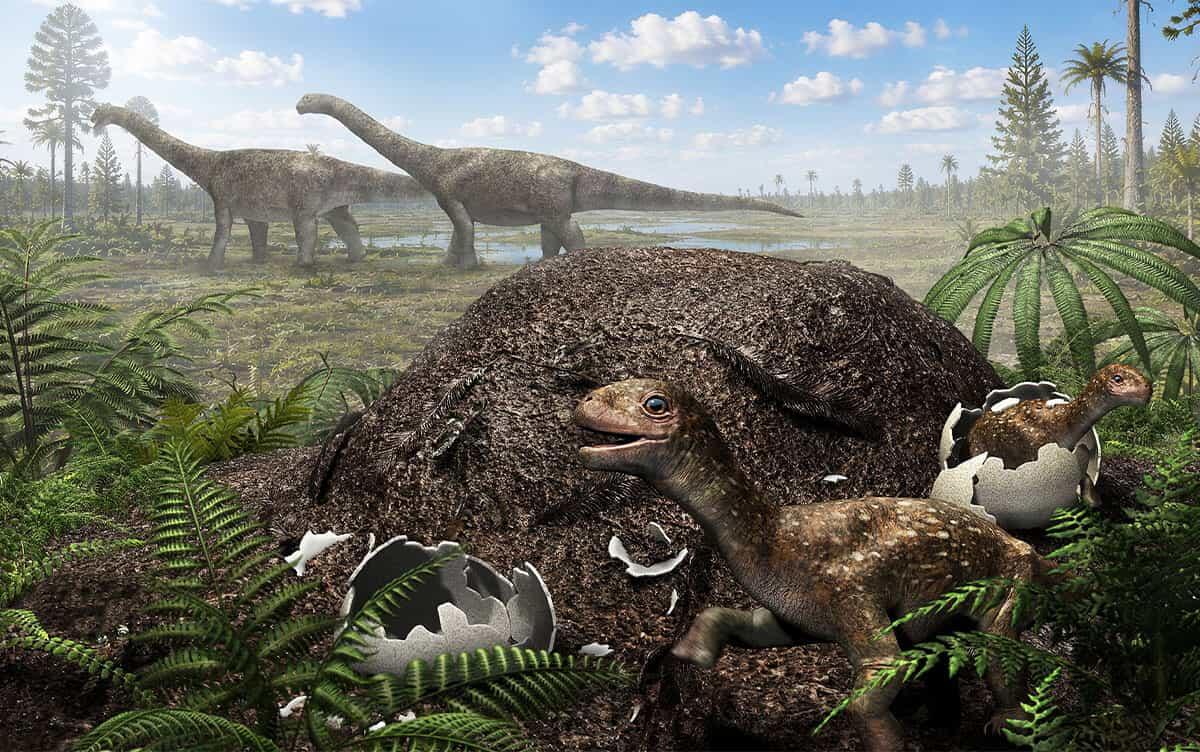 Image by Masato Hattori
An international research team led by University of Tsukuba has discovered fossilized eggshells of large herbivorous titanosaurs collected from the Late Cretaceous Chorrillo Formation in southern Argentina and inferred their nesting behavior. These titanosaur eggshells are the highest-latitude dinosaur eggshell fossils definitively identified in the Southern Hemisphere. The findings suggest that the dinosaurs buried their eggs in nest substrate in a relatively high-latitude environment and used heat generated within the nest to incubate them.
Tsukuba, Japan—Finding dinosaur eggshells dating back to the Cretaceous in high-latitude regions is rare. While discoveries in the Northern Hemisphere, particularly from Canada (57-60° N in Late Cretaceous) and Siberia (70-75° N) have been reported, confirmed reports of such findings from high-latitude regions in the Southern Hemisphere are limited.
In this study, the research team analyzed more than 250 eggshells collected from the Chorrillo Formation, located at 55-60° S during the latest Cretaceous period approximately 69-66 million years ago. Analysis of the eggshell microstructure revealed that all specimens examined exhibit features characteristic of Fusioolithus, a distinctive type of fossil egg most likely laid by titanosaurs, which were giant, long-necked herbivorous dinosaurs. The numerous microscopic pores on the eggshells indicate that the eggs were completely buried in nest substrate, such as soil and organic matter, in a high-humidity environment during incubation. Given the high-latitude location of the Chorrillo Formation, the researchers infer that the eggs were most likely incubated using heat generated by the microbial decomposition of organic matter, such as plant material, contained within the nest.
The Chorrillo Formation represents the highest-paleolatitude locality in the Southern Hemisphere from which dinosaur eggshells have been definitively identified. These discoveries show that titanosaurs adapted their nesting strategy to local environmental conditions to successfully reproduce, even in relatively high-latitude regions of the Southern Hemisphere.
###
This research was funded by Japan Society for the Promotion of Science [22K03800] (to KT and MM) and by an NSERC (RGPIN 04697) Discovery Grant (to DKZ).
Original Paper
- Title of original paper:
- Titanosaur eggshells from the latest Cretaceous of Patagonia, Argentina: implications for nesting at high latitude
- Journal:
- Royal Society Open Science
- DOI:
- 10.1098/rsos.260333
Correspondence
Associate Professor TANAKA Kohei
Institute of Life and Environmental Sciences, University of Tsukuba
Director General MANABE Makoto
National Museum of Nature and Science, Japan
Related Link
Institute of Life and Environmental Sciences
