


Research News
Ocean Warming and Herbivorous Fish Grazing Drive Kelp Forest Collapse Along Japan's Izu Peninsula
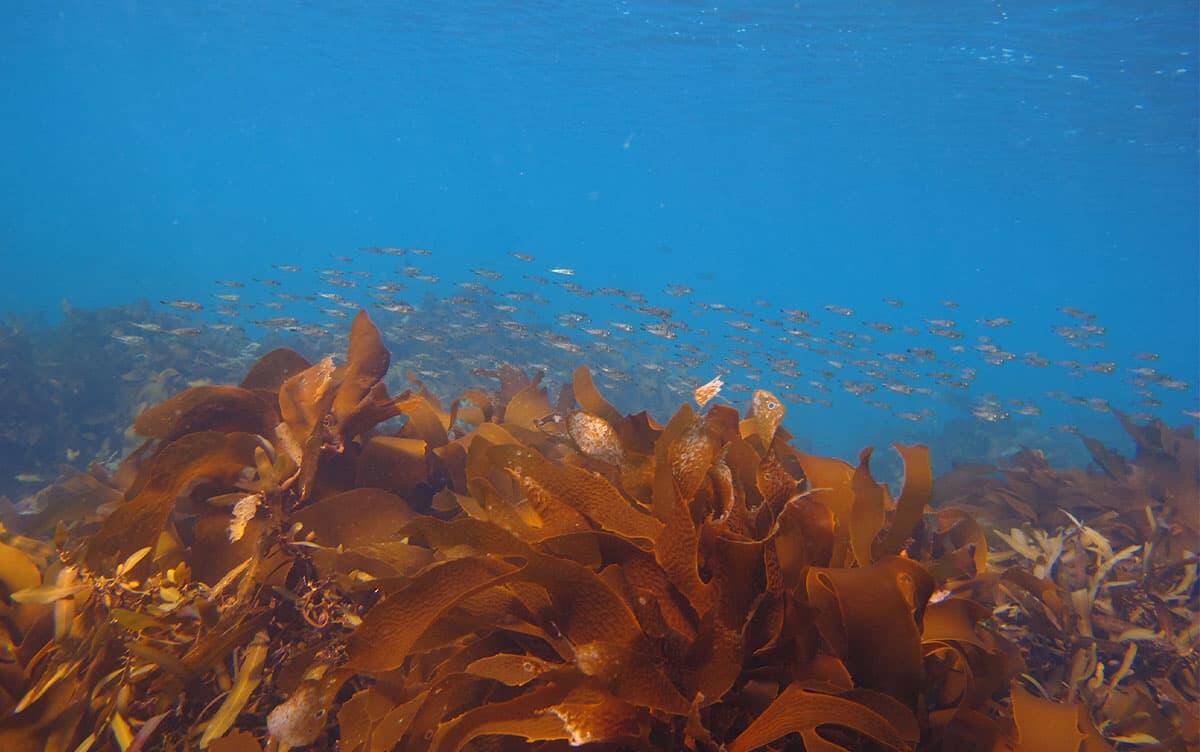 photo by Shigeki Wada
Researchers at University of Tsukuba have identified unprecedented ocean warming and prolonged grazing by herbivorous fish as key drivers of kelp forest collapse along Japan's Izu Peninsula. By combining more than 40 years of ecological observations with satellite-derived climate records and laboratory experiments, the team found that marine heatwaves pushed kelp beyond its thermal tolerance limits, while warming conditions substantially extended the grazing season for herbivorous fish.
Tsukuba, Japan—Kelp forests, ecosystems formed by large brown seaweeds in coastal waters, provide habitats for numerous fish and invertebrates and are vital to coastal productivity and carbon cycling. However, in recent years, kelp forests have declined throughout Japan, alongside the the spread of isoyake, a phenomenon in which rocky reefs become largely devoid of large seaweeds. This ecological shift has been primarily attributed to rising sea temperatures and intensified grazing by herbivorous fish.
To identify the drivers behind this collapse, researchers investigated the causes of kelp forest decline by integrating more than 40 years of data on the biomass of Ecklonia cava (kajime kelp) and long-term surveys of kelp cover across approximately 200 km of the Izu Peninsula coastline. These datasets were combined with satellite-derived sea surface temperature and marine heatwave records, field surveys of herbivorous fish, and laboratory experiments examining the thermal tolerance of E. cava.
The study found that the Izu coast experienced a dramatic surge in warming and marine heatwave activity from 2017 to 2025, during the prolonged Kuroshio Large Meander event. Laboratory experiments demonstrated that the photosynthetic performance of E. cava declined rapidly at temperatures above approximately 29.5°C. At the same time, warming extended the annual window of temperatures suitable for herbivorous fish grazing by up to 86 days. These findings suggest that the combination of heat-induced physiological stress and a longer grazing season has hindered E. cava recovery, ultimately contributing to widespread loss of kelp forests and the transition to isoyake conditions along the Izu Peninsula.
###
This work was supported by the Japan Society for the Promotion of Science (JSPS) Core-to-Core Program (grant number JPJSCCA20210006) and Grant-in-Aid for Scientific Research (B) (grant number 23K26924) to B.P.H, S.A. and S.W.. B.P.H. was also supported by the Organization for DESIGN THE FUTURE of University of Tsukuba in Japan. Financial support was also provided through the MEXT (Ministry of Education, Culture, Sports, Science and Technology, Japan) initiative for Educational and Research Organization Reform, under the program entitled "Construction of a University-wide, Cross-disciplinary Research Promotion Platform for Solving Global-scale Challenges.". D.A.S. was supported by a UKRI Future Leaders Fellowship (MR/X023214/1).
Original Paper
- Title of original paper:
- Unprecedented warming and increased herbivory drive collapse of Japan's kelp forests
- Journal:
- Global Change Biology
- DOI:
- 10.1111/gcb.71106
Correspondence
Assistant Professor Ben P. Harvey
Institute of Life and Environmental Sciences, University of Tsukuba
Related Link
Institute of Life and Environmental Sciences
