


Research News
Sound without Physical Force can Create a Sense of Resistance to Hand Movement
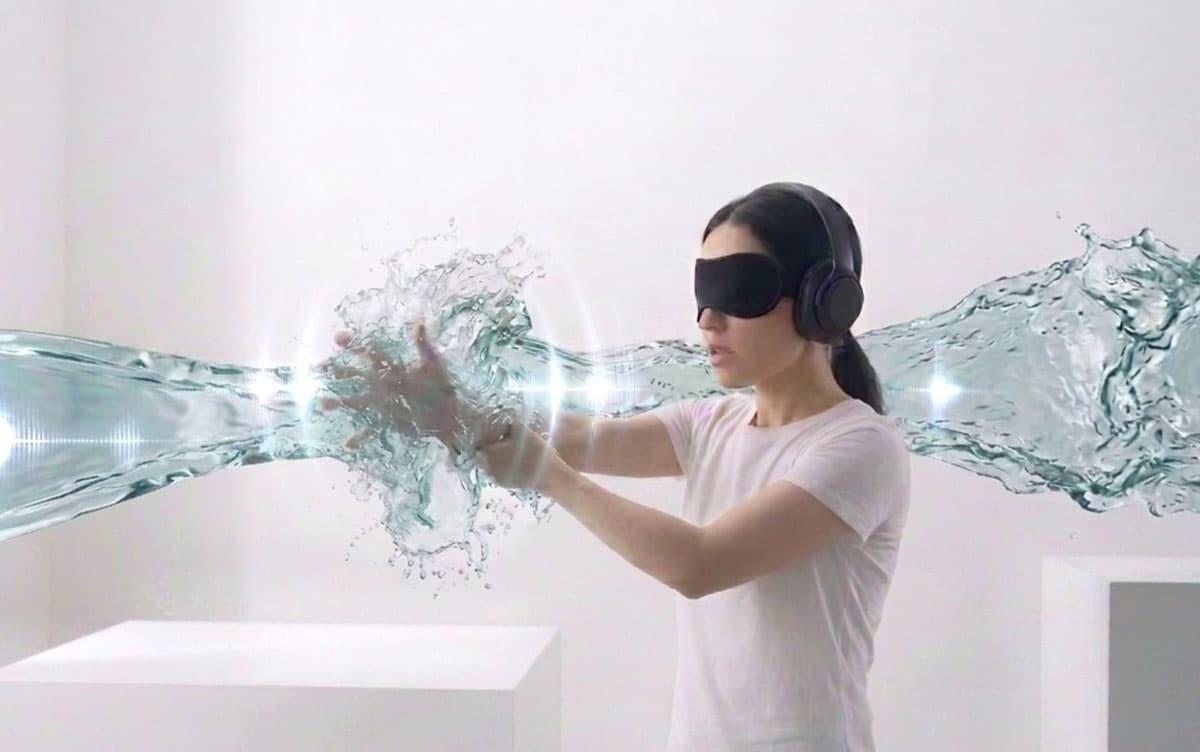 Concept illustration [Generated with Firefly]
Researchers at University of Tsukuba demonstrated that a human hand senses resistance against a water current when the pitch and perceived location of water sounds alone are manipulated in a river-simulating environment. This finding suggests that auditory cues influence perceptions of resistance and assistance differently. This research may inform the development of systems that communicate the boundaries of virtual spaces and the presence of obstacles to visually-impaired individuals, eliminating reliance on visual information.
Tsukuba, Japan—Virtual reality and augmented reality strongly rely on visual information; consequently, they are inaccessible to individuals with visual impairments. To create illusions of tactile feedback or force sensations without physical contact, previous studies have primarily relied on visual manipulations, such as altering the apparent position of objects, with lesser attention given to the potential of solely perceiving sound.
In this study, the researchers demonstrate that sound alone can recreate the experience of the side-to-side movement of a hand placed in flowing water. The researchers manipulated the pitch and location of the sound and investigated the changes in perceived resistance and assistance. Participants were blindfolded and provided with headphones that delivered multiple auditory stimuli. Furthermore, their hand movements were tracked using a smartphone camera. The participants reported conditions based on the ease or difficulty of hand movements.
The experiments showed that sound variations alone, in the absence of any physical force, can result in user biases toward the sensations of movement against a water current. Perceived resistance was particularly enhanced by increasing the sound pitch and was further strengthened by combining a higher pitch with an auditory displacement that shifted the perceived sound location away from the hand. Conversely, lowering the pitch or shifting the sound in the direction of movement did not reliably produce sensations of assistance or forward motion by the current. These findings suggest that auditory cues influence perceptions of resistance and assistance differently, with resistance-related effects emerging more robustly than assistance-related effects.
These findings may inform the development of sound-based technologies that alert people with visual impairments to the boundaries of virtual spaces or the presence and approach of obstacles.
###
This study was supported by JSPS KAKENHI (Grant Numbers 24H00892 and 25K24829) and JST SPRING (Grant Number JPMJSP2124), Japan.
Original Paper
- Title of original paper:
- Hand-in-River: Design of Direction-Dependent Virtual Cues of Assistive/Resistive Force via Auditory Displacement and Pitch Variation
- Journal:
- Applied Acoustics
- DOI:
- 10.1016/j.apacoust.2026.111579
Correspondence
Associate Professor ZEMPO Keiichi
Institute of Systems and Information Engineering, University of Tsukuba
Related Link
Institute of Systems and Information Engineering


