


Research News
Sequential Peaks in Arthropod Availability Across Snow and Vegetation Help Sustain Alpine Birds
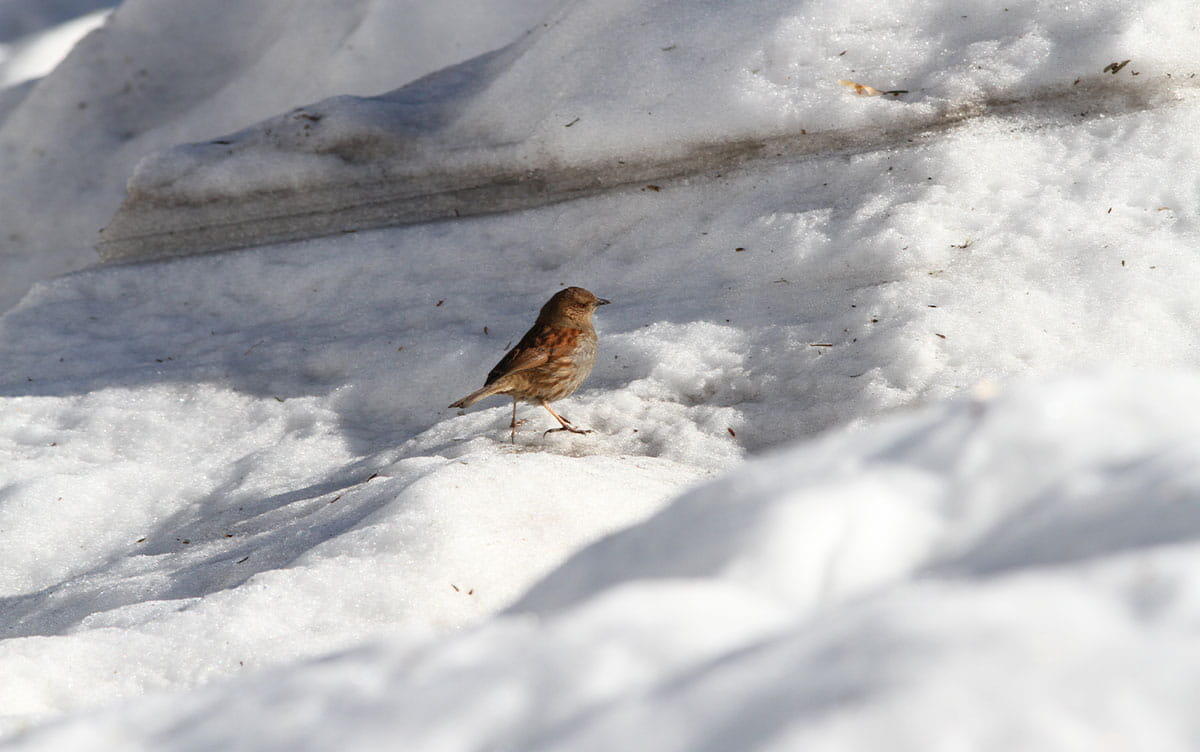
Researchers at University of Tsukuba found that arthropods deposited on alpine snowpacks and those living in alpine vegetation peaked in abundance at different timings during the growing season. This sequential availability creates resource waves that may extend the seasonal availability of arthropod resources for alpine birds throughout the breeding season. The findings suggest that conserving mosaic landscapes, where snowfields and vegetation coexist, could become increasingly important as climate change alters snowfall and snowmelt timings in mountain ecosystems.
Tsukuba, Japan—The alpine zone is located above the tree line in mountainous regions and is characterized by long winters and short growing seasons. Birds and other animals inhabiting these environments breed during a limited period extending from spring to summer. Arthropods, including insects and spiders, serve as an essential food resource during this time. Alpine animals feed on arthropods living in alpine vegetation, as well as those transported from forests at lower elevations and deposited on the remaining snowpacks. However, changes in the availability of these different food resources throughout the growing season remain poorly understood.
In this study, researchers surveyed three mountains in the Japanese Alps (Mount Tateyama, Mount Norikura, and Mount Kisokoma) at half-month intervals from late May to early August over 2 consecutive years. Arthropods were collected from snowpacks, Japanese stone pine scrubs, and alpine grasslands to investigate seasonal changes in taxonomic composition, abundance, and biomass. Aphids were found to dominate arthropod communities on snowpacks, whereas flies were most abundant in vegetation. Arthropod abundance peaked earliest on snowpacks (June), followed by Japanese stone pine scrubs (June-July), and latest in alpine grasslands (July-August). Biomass showed a similar seasonal pattern, peaking on snowpacks early in the season and increasing later in vegetation, with biomass increasing earlier in Japanese stone pine scrubs than in alpine grasslands.
A resource wave is the phenomenon in which food resources become available at different timings across habitats, enabling animals to prolong foraging opportunities by moving among locations. This study shows that alpine birds may benefit from a resource waves created by sequential peaks of arthropod resources across snowpacks and vegetation. By shifting their foraging habitats as the season progresses, these birds may be able to use food resources continuously from early spring through midsummer. The findings further highlight the ecological importance of alpine landscapes in which remaining snowfields and vegetation coexist, as these habitat mosaics provide complementary food resources over time and may help sustain biodiversity in alpine ecosystems.
###
This work was supported by the Japan Society for the Promotion of Science (JSPS) through Grants-in-Aid for Scientific Research 23KJ1792 and 24K18193.
Original Paper
- Title of original paper:
- Resource waves across snowpacks and alpine vegetation extend seasonal resource availability in alpine ecosystems
- Journal:
- Journal of Animal Ecology
- DOI:
- 10.1111/1365-2656.70371
Correspondence
Assistant Professor IIJIMA Daichi
Institute of Life and Environmental Sciences, University of Tsukuba
Associate Professor OSAWA Takeshi
Faculty of Urban Environmental Sciences, Tokyo Metropolitan University
Related Link
Institute of Life and Environmental Sciences

