


Research News
New Body-Actuation Interface for Faster Movement Initiation While Maintaining User Control
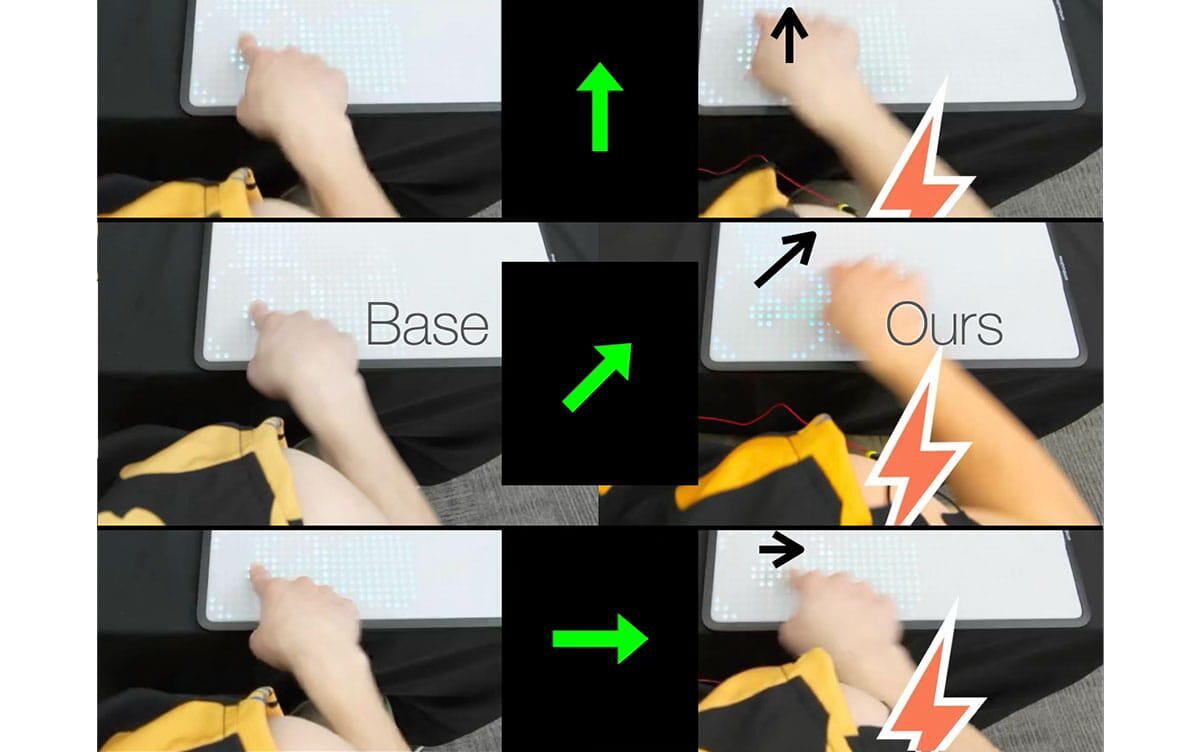 Provided by OCHIAI Yoichi
Researchers at University of Tsukuba have developed MuscleJockey: a novel body-actuation interface that combines electrical muscle stimulation with an auditory cue to hasten the initiation of body movement while the user controls its direction. The researchers demonstrated that MuscleJockey reduced the interval from the auditory cue to movement onset by 63 ms while maintaining directional accuracy.
Tsukuba, Japan—Many daily and specialized activities, including rapid responses in sports, split-second actions in video games, and synchronization during musical performance, require people to execute a prepared movement immediately after receiving a signal. However, with prior preparation of a movement, several hundred milliseconds are typically required to initiate movement after cue detection. Although electrical muscle stimulation (EMS), which activates muscles through electrical stimulation, can accelerate movement initiation, a key challenge remains: if initiation is left entirely to the machine, unintended movements may occur, but relying entirely on the user limits the potential speed advantage of the machine.
In this study, the researchers focused on a pattern observed in many movements: proximal muscles, closer to the torso, act earlier to drive movement, while distal muscles contribute to movement control and directional adjustment. Based on this principle, the researchers proposed MuscleJockey, a design concept for body-actuation interfaces that divides responsibilities between the user and machine. The machine determines movement initiation while the user determines the movement direction. A prototype was developed where EMS is applied only to the deltoid muscle at the shoulder to initiate movement while the user guides the resulting arm movement toward a direction prepared in advance.
In experiments involving 12 participants, EMS delivered to the shoulder along with an auditory cue reduced the movement initiation time by 63 ms on average compared with the condition of no stimulation. The overall error rate was only 1.4%, and no significant differences were observed among stimulation conditions. These findings indicate that movement initiation can be accelerated while the user retains directional control.
These results suggest a new approach to designing body-actuation interfaces with potential applications in sports, gaming, and collaborative musical performances.
###
This work was supported by JST BOOST (JPMJBS2414), JSPS KAKENHI (JP24K20825), and Pixie Dust Technologies, Inc..
Original Paper
- Title of original paper:
- MuscleJockey: Motor Initiation via Electrical Muscle Stimulation While Preserving User Control
- Journal:
- Proceedings of the 39th Annual ACM Symposium on User Interface Software and Technology(UIST '26)
- DOI:
- 10.1145/3830398.3830685
Correspondence
Professor OCHIAI Yoichi
Institute of Library, Information and Media Science, University of Tsukuba
SUZUKI Shieru
Doctoral Programs in Informatics, Graduate School of Comprehensive Human Sciences, University of Tsukuba
Senior Researcher MATSUBARA Seito
Research Institute on Human and Societal Augmentation, National Institute of Advanced Industrial Science and Technology (AIST)
Related Link
Institute of Library, Information and Media Science


