


TSUKUBA FRONTIER
#050 Helping Researchers Improve Their Design Skills: The Power of Science Visualization
Professor TANAKA Sayoko, Institute of Art and Design

Many people create presentation materials for work or school. Modern software offers numerous features, and it is easy to overuse them, resulting in cluttered and confusing slides. However, by applying basic design principles, anyone can produce presentations more effective and easier to understand.
My work focuses on developing learning tools and assessment methods to enhance design skills, not only for researchers but also to raise the overall level of design competence in Japan.
Design That Is Accurate, Clear, and Appealing
Researchers and institutions frequently seek ways to make their presentation materials more accurate, communicative, and visually appealing. Even when considerable effort is invested, slides often contain excessive information or suffer from inconsistent fonts, colors, or misaligned elements. These problems typically arise from limited design awareness rather than from the content itself. By adhering to fundamental design principles, issues of clarity and comprehensibility can often be resolved with relative ease. Good design sense, however, cannot simply be taught; it is cultivated through regular observation and analysis of excellent examples, ranging from artworks to successful presentations by others. By studying designs that resonate with you, imitating effective techniques, and exchanging constructive feedback with peers, your design intuition will gradually sharpen.
Supporting Better Communication
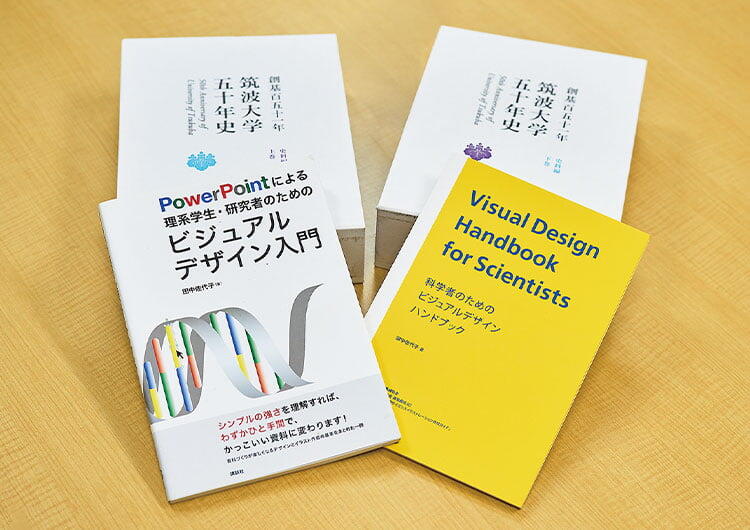
While content accuracy and design sense remain the researcher's responsibility, as a design specialist I focus on enhancing communication. Besides workshops on request, we have developed a free e-learning program so that more people can learn visual-design principles for research presentations.
As a new initiative, we created a rubric that enables objective self-assessment of design level and deeper understanding. With wider use, we expect both individual improvement and helpful feedback to further improve the program.
Applying design theory makes materials not only more beautiful but, more importantly, far easier to understand. This is why learning design is essential.
Visualizing Science with Creative Freedom
Explaining scientific research is inherently challenging. Since 2012, we have offered the undergraduate course Science Visualization Exercise, where students learn to express research visually and effectively. Faculty from medicine, biology, and other fields join me in teaching students from diverse backgrounds. Faculty provide illustration themes, and students create digital illustrations through trial and error. The fact that students are not domain experts often leads to fresh, creative ideas. This experience showed strong researcher interest in scientific visualization and directly led to the establishment of the Japanese Society for Science Visualization (JSSV).
In 2018, we launched the graduate course Visual Design for Research, based on our e-learning program. Despite initial uncertainty, it now attracts over 200 participants annually.
Raising Japan's Design Capability
Design is not just art; it is function. It is part of everyday life, determining the usability of tools and systems we use daily. The theory is not difficult, so learning the basics early benefits not only researchers but everyone involved in communication and problem-solving.
We are now exploring ways to introduce design education into junior high and high school curricula, not as art, but as part of information literacy. Through these efforts, we aim to raise Japan's overall design capability.
Profile
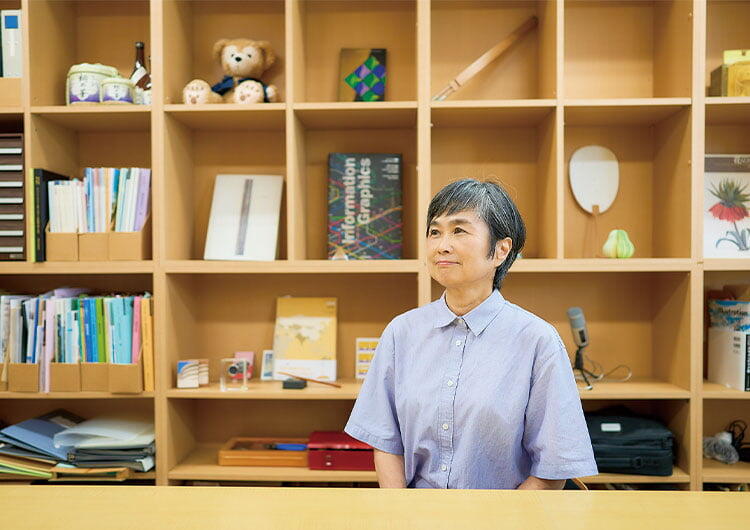
BA and MA from University of Tsukuba. Former graphic designer at GRAPH Co., Ltd., and Assistant Professor, Faculty of Design, Okayama Prefectural University.
Author of Introduction to Visual Design for Science Students and Researchers with PowerPoint (Kodansha, 2013).
(URL:https://www.geijutsu.tsukuba.ac.jp/~jssv/index.html)
Article by Science Communicator at the Bureau of Public Relations
TSUKUBA FRONTIER (PDF for printing)