


TSUKUBA FUTURE
#134 CO₂ Seeps—Nature's "Laboratory" Revealing the Future of Our Oceans
Assistant Professor, Benjamin Harvey, Institute of Life and Environmental Sciences

Drawing on his own research findings, Harvey—based at the Shimoda Marine Research Center of the University of Tsukuba (Shimoda City, Shizuoka Prefecture, Japan) states, "If global warming continues, ocean acidification will also accelerate. If we fail to stop it, the diversity of marine ecosystems will be lost. I want more people to understand what is happening in our oceans right now."
Today's seawater is mildly alkaline (pH around 8.1) but is gradually shifting toward acidity (below pH 7) as rising atmospheric concentrations of CO₂—a greenhouse gas—increase the dissolution of CO₂ into the ocean. This phenomenon, known as ocean acidification, is expected to have major impacts on marine ecosystems. For example, shellfish and corals build their shells and skeletons from calcium carbonate, a process made much more difficult by increasing acidity.
To explore the possible appearance of future oceans, Harvey uses a unique "natural laboratory" located approximately 50 km southwest of Shimoda, a town on Shikine Island in the Izu Islands (Niijima Village, Tokyo), where CO₂ seeps from the seafloor. This seepage phenomenon was first reported by the Shimoda Center's research team in 2015. Using the center's research vessel Tsukuba II (19 tons; length 17.9 m), the site can be reached in around two hours.
The average CO₂ concentration in the world's oceans is currently around 400 ppm (parts per million), but it could exceed 900 ppm by the end of the 21st century. Researchers from the University of Tsukuba measured the CO₂ levels around Shikine Island's seeps, finding a wide range—from 300 ppm to over 1,000 ppm—representing conditions equivalent to past, present, and future oceans.
Previous studies have shown that in areas with CO₂ concentrations of 900 ppm, corals and large seaweeds are much less abundant than in surrounding waters. These organisms build three-dimensional structures on the seafloor that provide habitats for other organisms. At around 900 ppm, however, these structures disappear, followed by a decline in fish diversity.
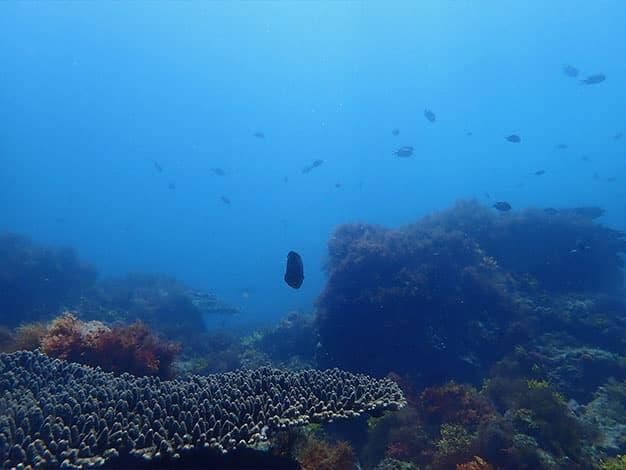
A rich ecosystem with corals and diverse marine life is present.
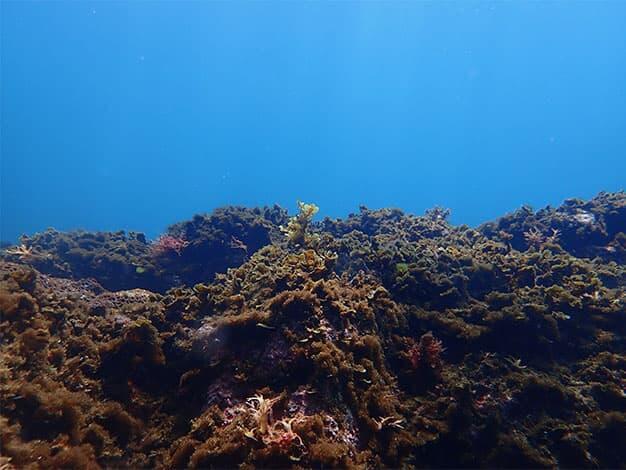
Small algae and similar organisms are abundant, but overall diversity is low.
Can lost biodiversity be restored?
Harvey and his team conducted an experiment in the CO₂ seep area, which can be regarded as a true natural laboratory. They placed five square tiles (15 cm on each side) in both high-CO₂ (900 ppm) and normal waters and observed them over six months. In normal waters, large seaweeds attached to the tiles, creating diverse communities. In contrast, only small seaweeds covered the tiles in the 900-ppm zone, and fewer bottom-dwelling organisms were observed.
However, when tiles from the 900-ppm zone were moved to normal waters, they established the same state as their surroundings within a few months. This suggests that if ocean CO₂ levels can be restored to appropriate levels, ecosystems may recover. CO₂ seeps offer a unique research opportunity for conducting ecosystem-recovery experiments, which are difficult to replicate in land-based labs.
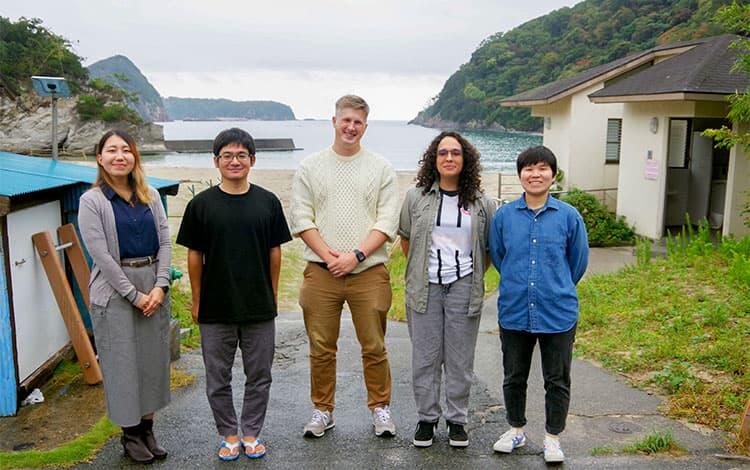
The center faces Nabeta Bay, a sub-bay of Shimoda Bay. At international conferences, the center actively introduces its students to researchers from around the world to help them gain opportunities to showcase their work.
Harvey, originally from Norwich in eastern England, earned his Ph.D. in Marine Climate Change Ecology at Aberystwyth University in Wales. On the recommendation of his adviser, he came to Japan in 2016, saying, "I was drawn to the chance to study CO₂ seeps, which show us the future of our oceans." Initially planning a short stay, he instead remained over the long-term, captivated by Japan's beautiful, diverse coastlines and the warm community in Shimoda.
Although based in Shimoda, Harvey actively collaborates with researchers worldwide. A paper published in Nature this September is one achievement of these collaborative efforts. Co-authored with researchers from the University of Exeter, the study showed that if global temperatures rise by 2°C above pre-industrial levels, growth of nearly all coral reefs will cease, increasing coastal flooding risks.
The study examined around 400 coral reef sites in the tropical western Pacific, including Florida and Mexico, and analyzed fossil reefs to calculate their growth rates. The results revealed that most reefs are already growing more slowly than sea-level rise, and that more than 70% will be eroding by 2040. If temperatures rise more than 2°C by the end of the century, over 99% of these reefs will stop growing and the water depth above the reefs will increase by 0.7-1.2 m.
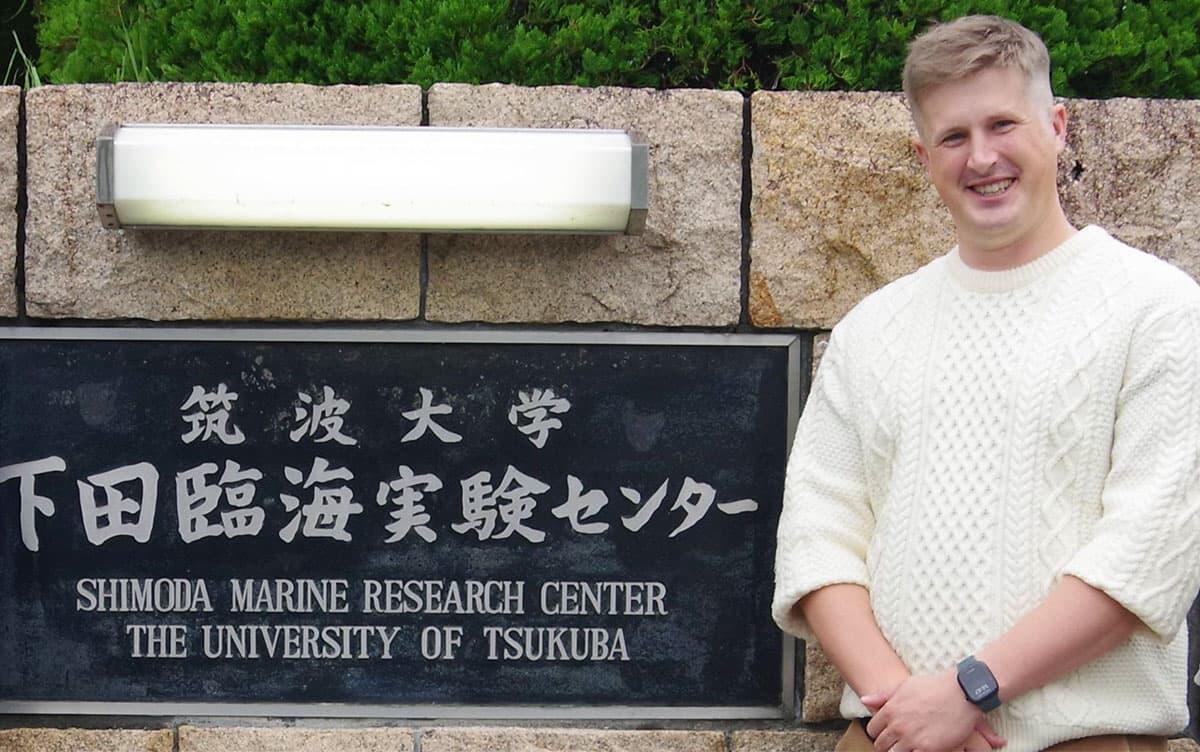
Although previous research has warned of coral reef decline, this study newly highlighted that before reefs disappear, they progressively lose their ability to build structure, leading to erosion. As a result, coasts become more vulnerable to waves and storm surges, providing critical data for future adaptation strategies.
Research from Shimoda will continue to contribute to global marine science.
Article by Science Communicator at the Bureau of Public Relations
Related Link
Assistant Professor Benjamin Harvey
Institute of Health and Sport Sciences