


Research News
Two Fundamental Coordination Patterns in Underwater Dolphin Kick Identified
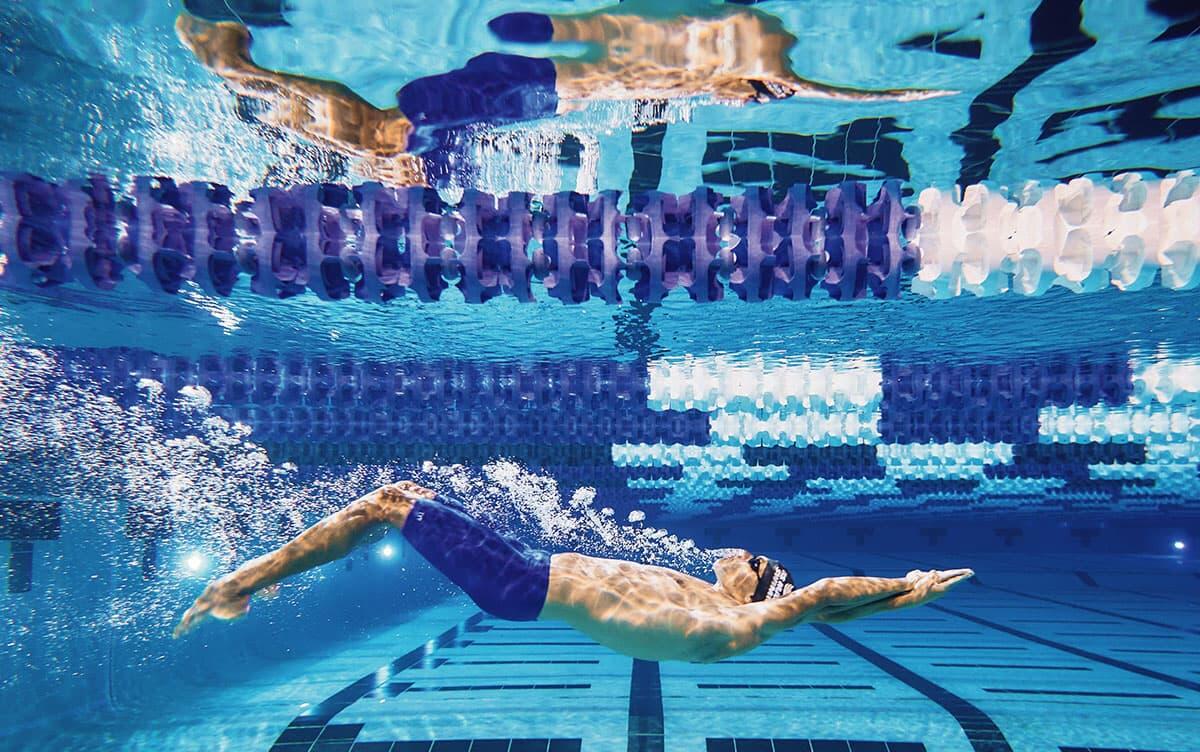 Image by Alexander Bezugliy/Shutterstock
Researchers at University of Tsukuba have identified two fundamental coordination patterns underlying the underwater dolphin kick in swimmers: (1) the coordinated motion of the shank and foot and (2) hip flexion and extension centered on thigh movement. They also found that faster swimmers employ a distinctive arm-trunk-thigh coordination strategy employed by faster swimmers, who maintain a streamlined upper body by adjusting shoulder and lower trunk movements in response to thigh motion.
Tsukuba, Japan—The underwater dolphin kick is a swimming technique in which propulsion is generated solely through the undulatory motion of the lower limbs, increasing swimmers' speed by moving the body in a wavelike pattern similar to fish or marine mammals. However, because the human body is not naturally adapted to such undulatory movements, swimmers must master advanced motor skills to improve performance in this technique.
This study analyzed time-series data of joint movements during underwater dolphin kick to examine differences in swimmer performance levels. Using conducting kinematic synergy analysis, the researchers identified two primary coordination patterns in this technique—the coordinated motion of the shank and foot, and hip flexion and extension centered on thigh movement. Together, these two synergies accounted for over 99% of the movement across all performance levels. Importantly, faster swimmers performed greater shoulder extension during the downward kick and displayed increased lower trunk movement during the upward kick. This arm-trunk-thigh coordination helps swimmers maintain a horizontal upper body and reduce water resistance throughout the kicking cycle.
This research is the first to identify the coordination patterns in underwater dolphin kick using kinematic synergy analysis. Its findings offer valuable insights into the refinement of underwater dolphin kick drills and the effective design of land-based training programs. Future studies are expected to apply similar analyses to other swimming techniques that involve more complex movements.
Original Paper
- Title of original paper:
- Joint kinematics and inter-segmental coordination during underwater undulatory swimming: Comparing swimmers of different performance levels
- Journal:
- Journal of Biomechanics
- DOI:
- 10.1016/j.jbiomech.2025.113085
Correspondence
Assistant Professor YAMAKAWA Keisuke
Institute of Health and Sport Sciences, University of Tsukuba
Related Link
Institute of Health and Sport Sciences


