


Research News
Unraveling the Physics Behind Kamchatka's 73-Year Earthquake Cycle
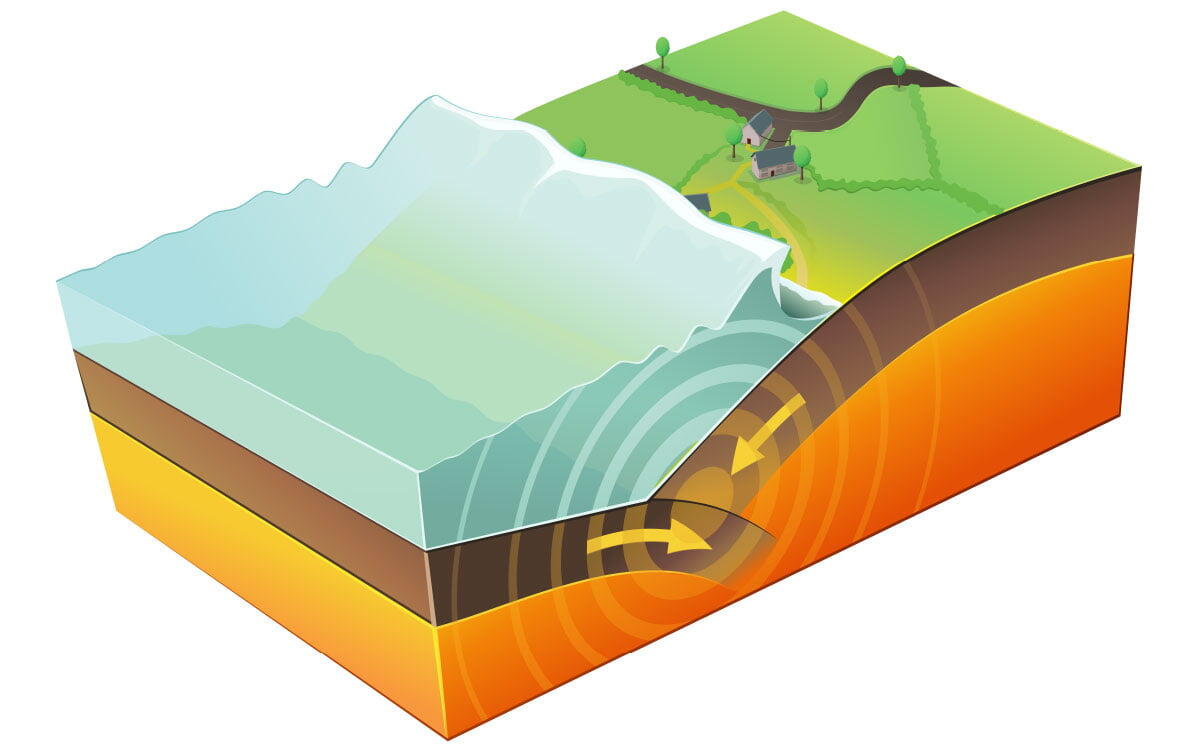 Image by Drazbedel/Shutterstock
A research team from University of Tsukuba and collaborating institutions has clarified why M9-class megathrust earthquakes recur off the Kamchatka Peninsula with an unusually short cycle of 73 years. By analyzing the rupture process of the 2025 event, the team demonstrated that this earthquake exhibited complex behavior that cannot be explained by conventional seismic-cycle models.
Tsukuba, Japan—In July 2025, a massive earthquake with a magnitude of 8.8-8.9 struck off the Kamchatka Peninsula, Russia. Notably, this event ruptured nearly the same region as the M9.0-class earthquake of 1952, yet the recurrence interval was only 73 years—far shorter than expected for such giant earthquakes, thereby challenging conventional seismological understanding.
In this study, the researchers estimated the rupture process of the 2025 Kamchatka earthquake using the Potency Density Tensor Inversion (PDTI) method, originally developed at the University of Tsukuba. The analysis showed that the fault slip reached 9-12 m across a broad area, substantially exceeding the ~6 m of slip deficit accumulated since 1952, and that slip accelerated twice within the large-slip zone. Following the mainshock, low-angle normal-faulting aftershocks, opposite to the direction of plate convergence, were concentrated near the plate boundary. This observation indicates that dynamic overshoot occurred during the mainshock, leading to a local reversal of shear stress. Based on these results, the team concluded that residual strain left unresolved by the 1952 earthquake combined with post-1952 strain, and that this accumulated strain was largely released during the 2025 event.
The study emphasizes that variations in rupture physics and stress release can leave substantial residual strain after a major earthquake, thereby disrupting regular recurrence intervals. These findings indicate that real-world megathrust earthquakes exhibit complex, nonperiodic behavior that cannot be fully explained by conventional seismic-cycle models. The results have important implications for long-term earthquake forecasting in subduction zones worldwide, including the Nankai Trough.
###
This research is supported by Japan Society for the promotion of Science (JSPS) Grantin-Aid for Scientific Research (B) 25K01075.
Original Paper
- Title of original paper:
- Breaking the Cycle: Short Recurrence and Overshoot of an M9-class Kamchatka Earthquake
- Journal:
- Seismica
- DOI:
- 10.26443/seismica.v4i2.2012
Correspondence
Professor YAGI Yuji
Institute of Life and Environmental Sciences, University of Tsukuba
Professor FUKAHATA Yukitoshi
Disaster Prevention Research Institute, Kyoto University
TAKAGAWA Tomohiro, PhD
Head of Tsunami and Storm Surge Research Group, Port and Airport Research Institute, National Institute of Maritime, Port and Aviation Technology
Professor TODA Shinji
International Research Institute of Disaster Science (IRIDeS), Tohoku University
Related Link
Institute of Life and Environmental Sciences

