


Research News
Revealing the Diversity of Olfactory Receptors in Hagfish and its Implications for Early Vertebrate Evolution
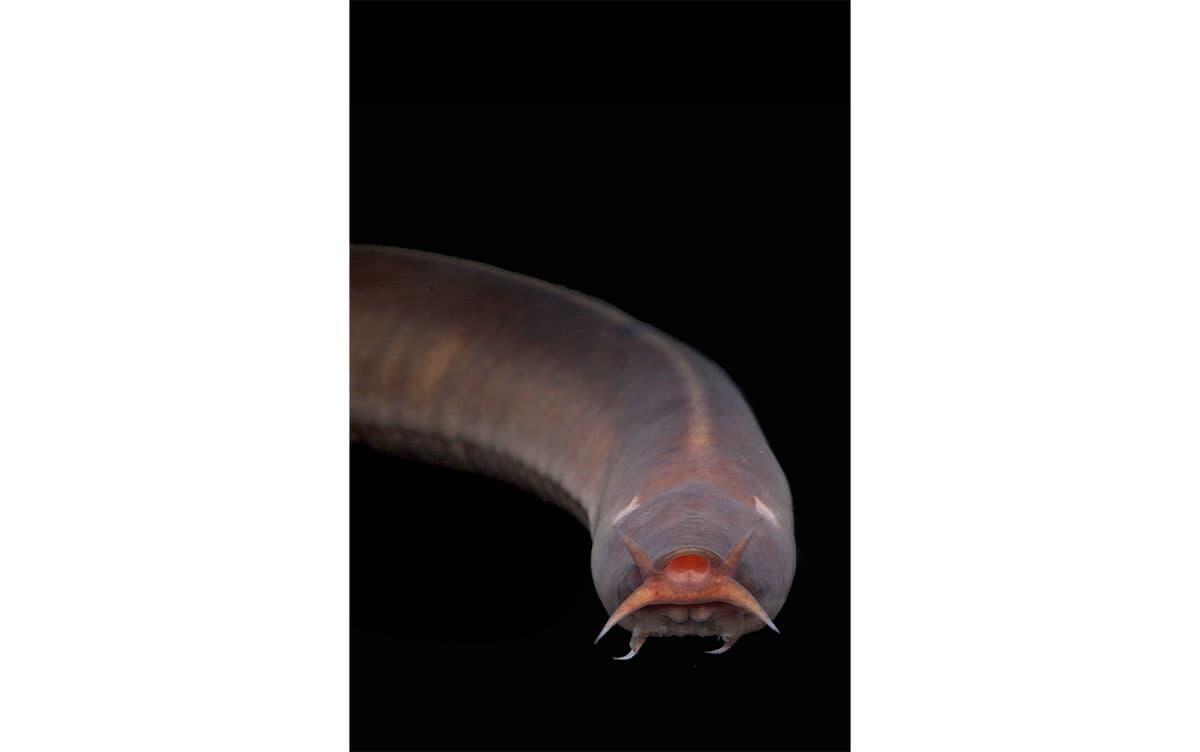 Photo by Tsukuru Maeda
Researchers at University of Tsukuba and their collaborators have conducted a comprehensive analysis of the olfactory receptor repertoire of the hagfish (Eptatretus burgeri), a jawless vertebrate. This organism retains many primitive features yet possesses a highly developed olfactory system. The researchers' findings reveal that certain olfactory receptor gene families have undergone substantial lineage-specific diversification, suggesting that the vertebrate common ancestor likely possessed a broader and more complex olfactory repertoire than previously proposed.
Tsukuba, Japan—Animals, including humans, rely on their sense of smell to locate food, avoid predators, and communicate. This sensory ability depends on specialized receptor proteins. In vertebrates, four major receptor families mediate olfaction; these include olfactory receptors (ORs), vomeronasal type 1 receptors (V1Rs), vomeronasal type 2 receptors (V2Rs), and trace amine-associated receptors (TAARs). However, the evolutionary origin and early diversification patterns of these receptor classes remain poorly understood.
In this study, University of Tsukuba researchers examined the hagfish genome for genes linked to ORs. In total, they identified 48 OR genes, 2 V1R genes, a surprisingly large set of 135 V2R genes, and no TAAR gene. Subsequent expression analyses confirmed that most of these genes were actively expressed in the olfactory organ, indicating that they may play functional roles in smell perception. Notably, the presence of true V2Rs in hagfish overturns the long-standing assumption that these receptors evolved only in jawed vertebrates. Conversely, the results of this study suggest that functional V2Rs were already present in the common ancestor of all vertebrates and that they subsequently diversified in a lineage-specific manner. Overall, this discovery provides critical insight into the evolution of vertebrate olfaction and underscores the importance of hagfish as a model for reconstructing the sensory biology of early vertebrates.
###
This work was supported by the Grant-in-Aid for the Japan Society for the Promotion of Science (JSPS; Grant Numbers JP20K15855, JP22K15164, JP24K09556, and JP24H01538 to D.G.S, and JP19K16178 to Y.Y.) and by the Sasakawa Scientific Research Grant from The Japan Science Society (Grant Number 2023-4098 to H.K.).
Original Paper
- Title of original paper:
- Hagfish olfactory repertoire illuminates lineage-specific diversification of olfaction in basal vertebrates
- Journal:
- iScience
- DOI:
- 10.1016/j.isci.2025.114118
Correspondence
Assistant Professor SUZUKI Daichi G.
Institute of Life and Environmental Sciences, University of Tsukuba
KARIYAYAMA Hirofumi
(Current position: Visiting Researcher of the RIKEN Center for Biosystems Dynamics Research (BDR))
Graduate School of Comprehensive Human Sciences, University of Tsukuba
Assistant Professor YAMAGUCHI Yoko
Institute of Agricultural and Life Sciences, Academic Assembly, Shimane University
Related Link
Institute of Life and Environmental Sciences
