


Research News
Discovery of a Photophobic Response in Apusomonads Reveals Insights into Opisthokont Origins
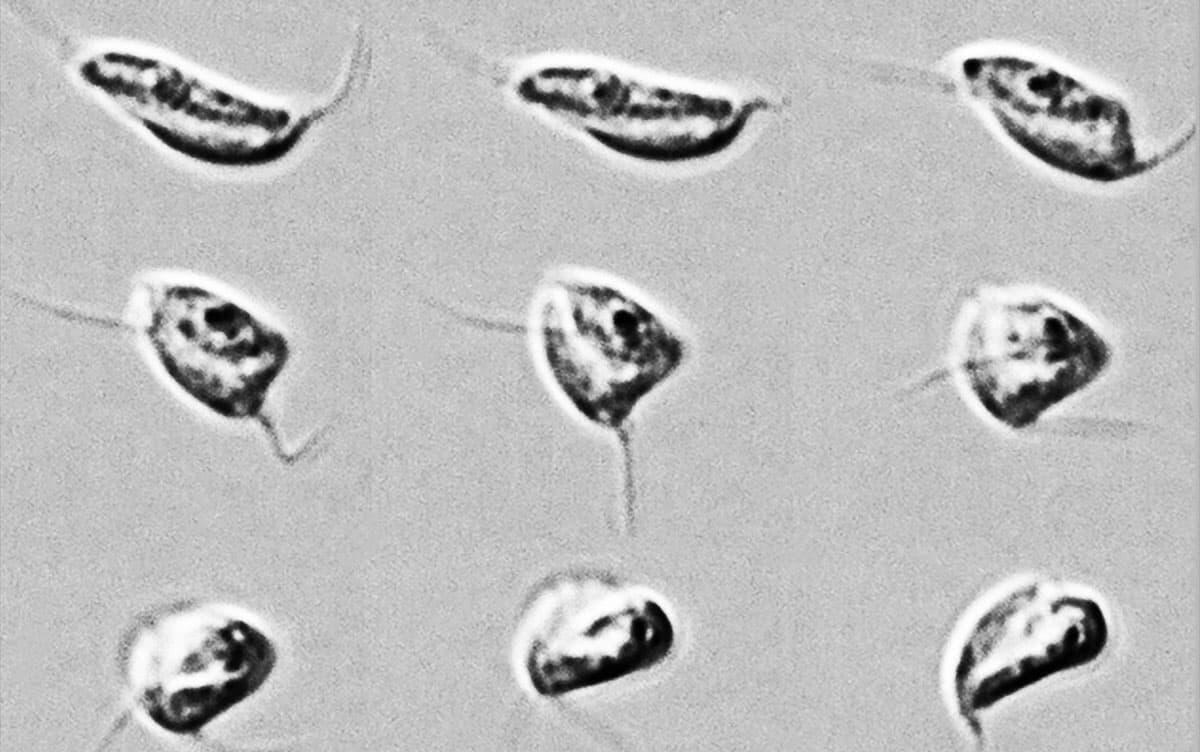 Provided by Kazuo Inaba
Researchers at University of Tsukuba have identified a photophobic response (light avoidance) in the unicellular apusomonad Podomonas kaiyoae. This discovery provides critical insight into the evolution of complex flagellar and ciliary motility and the evolutionary origins of Opisthokonta, a major eukaryotic group that encompasses animals and fungi.
Tsukuba, Japan—Light is a fundamental environmental factor influencing life on Earth, and light responsiveness is a universal trait among eukaryotes, both unicellular and multicellular. Apusomonads are biflagellated protists, and as the sister group of Opisthokonta, they occupy an essential position for understanding early eukaryotic evolution. While light responses, such as vision and circadian rhythms, are well-documented in animals, no photoresponsive behavior has previously been reported in apusomonads.
In this study, researchers observed for the first time that the apusomonad Podomonas kaiyoae exhibits a clear avoidance response to blue light. When exposed to blue light, the organism asymmetrizes the waveform of its posterior flagellum and simultaneously contracts its cell body. This behavior is triggered by an increase in intracellular calcium ion concentration and involves the coordinated action of two cytoskeletal systems: the dynein/tubulin motor system and the myosin/actin motor system. The functional dominance of the posterior flagellum in directional changes strongly supports the phylogenetic placement of apusomonads as the sister group of Opisthokonta.
Opisthokont ancestors relied on the posterior flagellum for locomotion, as seen in animal sperm, which can rapidly alter flagellar waveforms to change direction. By contrast, the posterior flagellum of apusomonads is less vigorous. The primitive mechanism combining posterior flagellar asymmetry with cell contraction observed in Podomonas kaiyoae provides an important clue to the evolution of high-speed flagellar and ciliary movements in opisthokonts.
###
This work was also supported, in part, by Grants-in-Aid for Scientific Research (A) (17H01440), Scientific Research (B) (25K02304), and Challenging Exploratory Research (15 K14566) from the Japan Society for the Promotion of Science, Japan; Grants-in-Aid for Innovative Areas (15H01201 and 15H01308) and Transformative Research Areas (21H05304) from the Ministry of Education, Culture, Sports, Science and Technology, Japan.
Original Paper
- Title of original paper:
- The photophobic response in the apusomonad Podomonas kaiyoae is mediated by coordination of cilia and actin filaments
- Journal:
- Communications Biology
- DOI:
- 10.1038/s42003-025-09209-y
Correspondence
Professor INABA Kazuo
Institute of Life and Environmental Sciences, University of Tsukuba
Related Link
Institute of Life and Environmental Sciences


