


Research News
Ancestral Motif Enables Broad DNA Binding by NIN, a Master Regulator of Rhizobial Symbiosis
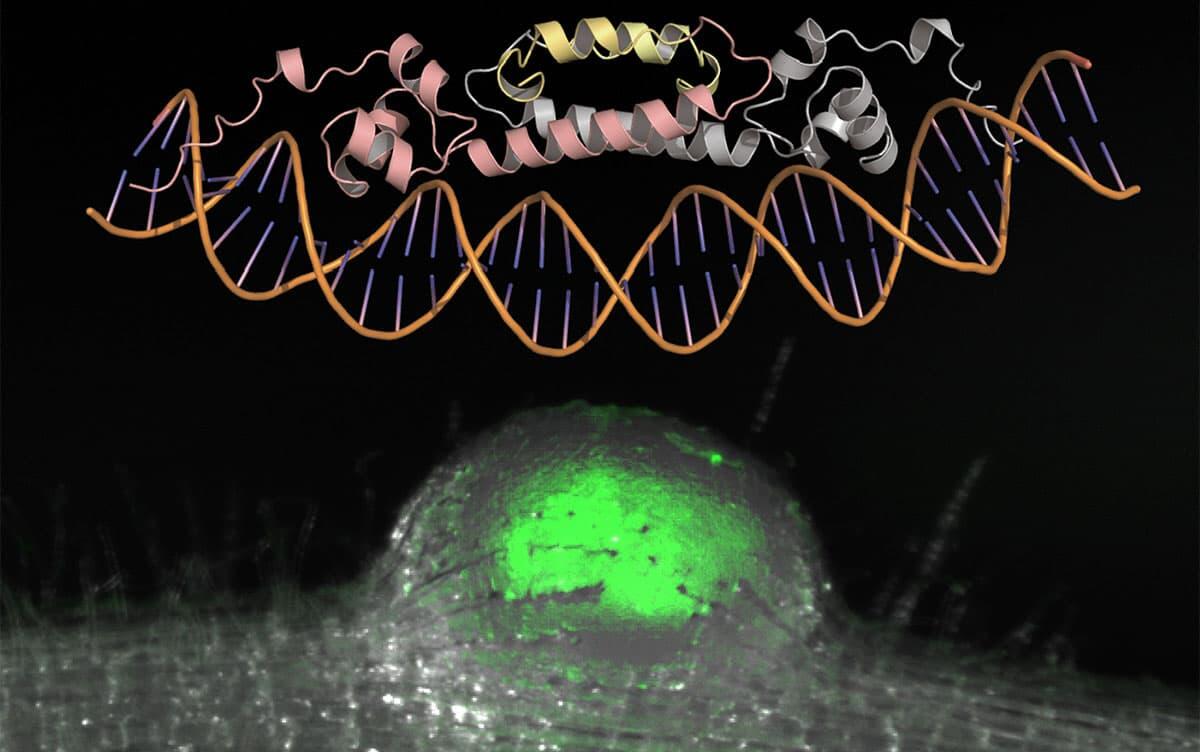
Researchers at University of Tsukuba have uncovered a master transcriptional regulator that controls rhizobial symbiosis between plants and nitrogen-fixing bacteria. By identifying an amino acid motif that emerged before the appearance of rhizobial symbiosis, they show that stabilization of DNA binding enabled this regulator to control a wide array of genes involved in nodule formation, bacterial infection, and symbiotic nitrogen fixation.
Tsukuba, Japan—Some plants, such as legumes, develop specialized root organs called nodules, within which they establish a symbiotic association with nitrogen‑fixing bacteria. Through this process, called rhizobial symbiosis, plants obtain nitrogen from the bacteria, which receive photosynthetically derived carbon compounds from plants. Clarifying the molecular basis of this interaction is of fundamental importance for plant biology and has significant implications for sustainable agriculture.
The transcription factor NODULE INCEPTION (NIN) is crucial for rhizobial symbiosis. Research shows that NIN regulates genes involved in nodule formation, rhizobia infection, and symbiotic nitrogen fixation, which converts atmospheric nitrogen into ammonia for the host plant. However, how NIN acquired the symbiosis‑specific regulatory functions that distinguish it from the closely related NIN‑LIKE PROTEIN (NLP) family members during plant evolution was unclear.
In the present study, the researchers investigated the molecular mechanisms whereby NIN can bind a broader spectrum of DNA sequences than its close homologs, using the legume Lotus japonicus (Miyakogusa) as a model system. They first identified a short amino acid motif located immediately downstream of the RWP-RK DNA binding domain, called the following RWPRK (FR) motif. Interestingly, this FR motif stabilizes dimer formation and confers broader DNA binding specificity to NIN than to NLPs. In L. japonicus, NIN mutants lacking the FR motif, exhibited severely impaired rhizobial infection and nitrogen fixation in nodules were severely impaired, demonstrating that the FR motif is essential for NIN function.
Further evolutionary analyses identified this FR motif in certain plant lineages that existed before the emergence of rhizobial symbiosis. These findings suggest that NIN evolved by co-opting preexisting molecular features of ancestral NLP transcription factors. This study highlights how relatively small structural modifications in transcription factors can create novel biological and regulatory functions, providing fundamental insights for to the future development of sustainable agricultural technologies.
###
This work was supported by Ministry of Education, Culture, Sports, Science and
Technology KAKENHI grant JP22K14824, JP24K01677 (S.N.), JP20H05908, JP23K27188, JP25H01345 (T.S.); JST Mirai Program JPMJMI20E4 (T.S.); JST ALC A-Next JPMJAN23D2 (T.S.); JST ACT -X Program JPMJAX21BL (S.N.); and JST SPRING JPMJSP2124 (M.N.).
Original Paper
- Title of original paper:
- The root nodule symbiosis regulator NIN exhibits broad DNA-binding specificity conferred by an NLP-inherited motif
- Journal:
- Science Advances
- DOI:
- 10.1126/sciadv.aeb8825
Correspondence
Assistant Professor NOSAKI Shohei
Professor SUZAKI Takuya
Institute of Life and Environmental Sciences, University of Tsukuba
Related Link
Institute of Life and Environmental Sciences


