


Research News
Experimental and Numerical Framework for Acoustic Streaming Prediction in Mid-Air Phased Arrays
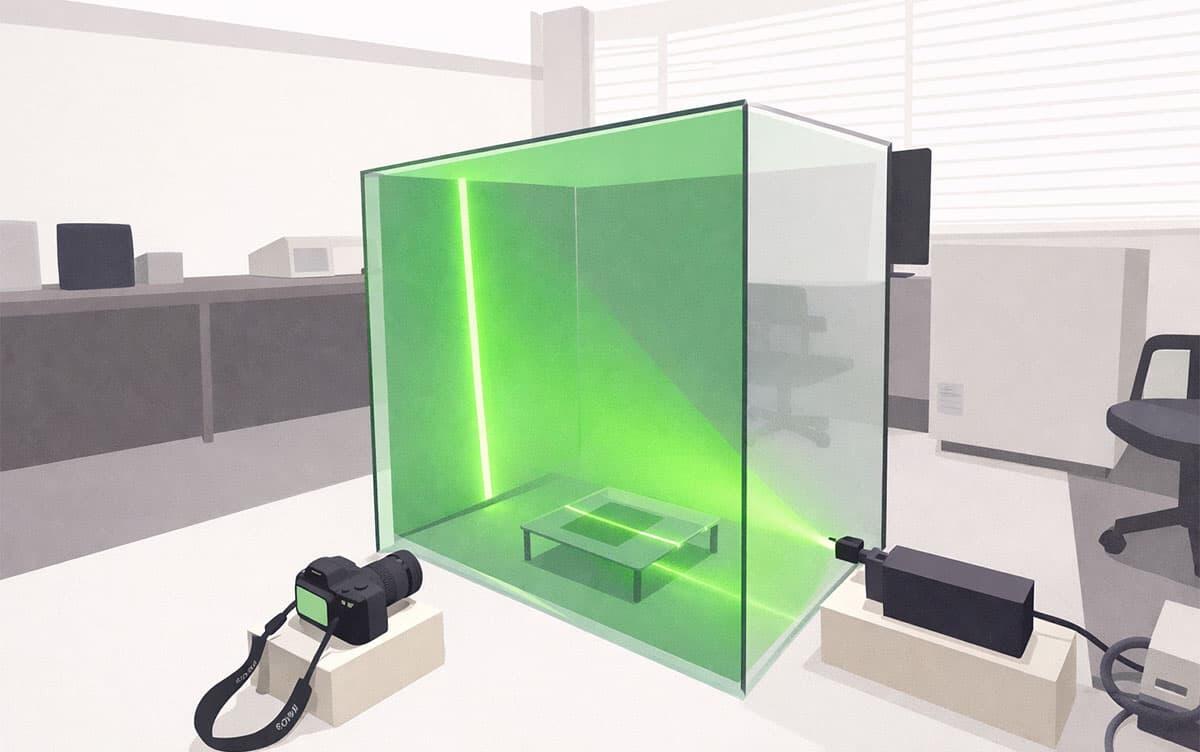 Provided by Tatsuki Fushimi
Acoustic streaming generated by airborne ultrasonic phased arrays plays a critical role in the performance of advanced ultrasonic technologies, including mid-air haptic feedback, odor delivery, and acoustic levitation. Researchers at University of Tsukuba have developed a predictive model for acoustic streaming in phased arrays by integrating three-dimensional acoustic and fluid simulations.
Tsukuba, Japan—Airborne ultrasonic phased arrays focus ultrasonic waves at prescribed locations in space and dynamically steer them, enabling applications such as noncontact tactile feedback, odor transport, and the levitation of small objects. Despite the nonnegligible influence of acoustic streaming—steady airflow induced by high-intensity sound fields—on tactile perception and the stability of levitated objects, reliable prediction and modeling of this phenomenon have remained challenging.
In this study, the research team visualized acoustic streaming using particle image velocimetry and used these measurements to validate numerical simulations for developing a model that systematically clarifies how sound-field control parameters, including focal length, beam shape, and input voltage, influence the spatial distribution and velocity of the induced flow. By varying these parameters, the proposed framework enables systematic prediction of acoustic streaming behavior under different operating conditions.
The results show that the streaming velocities generated by ultrasonic phased arrays consistently fall within the range predicted by thermoviscous and atmospheric attenuation models. This agreement indicates that the magnitude and spatial characteristics of acoustic streaming, which were previously difficult to estimate, can now be predicted in advance using a physics-based approach.
This work provides a foundation for precise control of acoustic streaming through sound-field design and offers practical guidance for the development of safer and more accurate ultrasonic interfaces, including mid-air haptic systems, odor delivery platforms, and acoustic levitation technologies.
###
This work was supported by Japan Science and Technology Agency (JST) as part of Adopting Sustainable Partnerships for Innovative Research Ecosystem (ASPIRE), Grant Number JPMJAP2330.
We would like to thank Murata Manufacturing Co., Ltd. for providing transducers used in experiments.
Original Paper
- Title of original paper:
- Experimental and Numerical Study of Acoustic Streaming in Mid-Air Phased Arrays
- Journal:
- npj Acoustics
- DOI:
- 10.1038/s44384-025-00040-7
Correspondence
Assistant Professor FUSHIMI Tatsuki
Institute of Library, Information and Media Science, University of Tsukuba
Related Link
Institute of Library, Information and Media Science, University of Tsukuba


