


Research News
Observation of Nonrandom Patterns of Spike D614 Reversions in SARS-CoV-2 Delta and Omicron BA.2
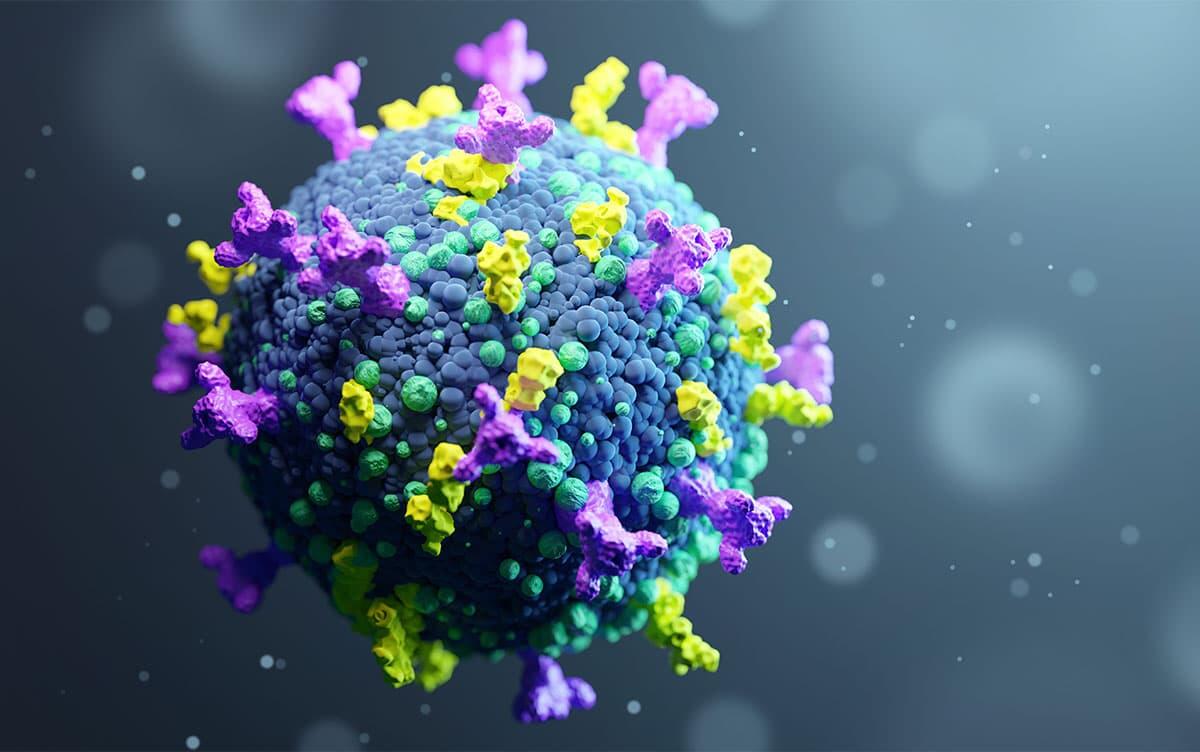 Image by solarseven/Shutterstock
Researchers from University of Tsukuba and Institute of Science Tokyo have identified nonrandom patterns in the emergence of spike D614 reversions in publicly available SARS-CoV-2 genomic data. Analysis of publicly available sequences revealed numerous instances in which the spike D614G substitution, previously associated with increased transmissibility, reverted from G614 to the ancestral D614 residue, with these events predominantly occurring in the Delta and Omicron BA.2 lineages. The detected reversions also exhibited nonrandom patterns in temporal occurrence and geographic distribution.
Tsukuba, Japan—SARS-CoV-2, the virus responsible for COVID-19, uses a protruding spike (S) protein to enter host cells. Early in the pandemic, the ancestral D614 residue in the spike protein was rapidly replaced by G614 (the D614G substitution), after which it became nearly fixed across variants of concern.
In this study, a comprehensive survey of spike sequences deposited in the NCBI GenBank public database was conducted. The analysis revealed that D614 reversions (reverse mutations from G614 back to D614) occurred disproportionately within the Delta and Omicron BA.2 lineages. These reversions were detected predominantly after the peak transmission periods of the respective lineage surges and showed clear geographic clustering. Taken together, these observations are not readily explained by spontaneous mutations arising during typical community transmission alone, highlighting the need to further elucidate the processes responsible for generating this pattern.
Original Paper
- Title of original paper:
- Anomalous Emergence of D614 Reverse Mutations in the Delta and Omicron BA.2 Variants
- Journal:
- Microbiology Research
- DOI:
- 10.3390/microbiolres17020044
Correspondence
Associate Professor KAKEYA Hideki
Institute of Systems and Information Engineering, University of Tsukuba
Related Link
Institute of Systems and Information Engineering


