


Research News
High-Resolution Cryo-EM Structure Reveals the Mechanisms Underlying Oxygen-Tolerant Energy Conversion in a Marine Photosynthetic Bacterium
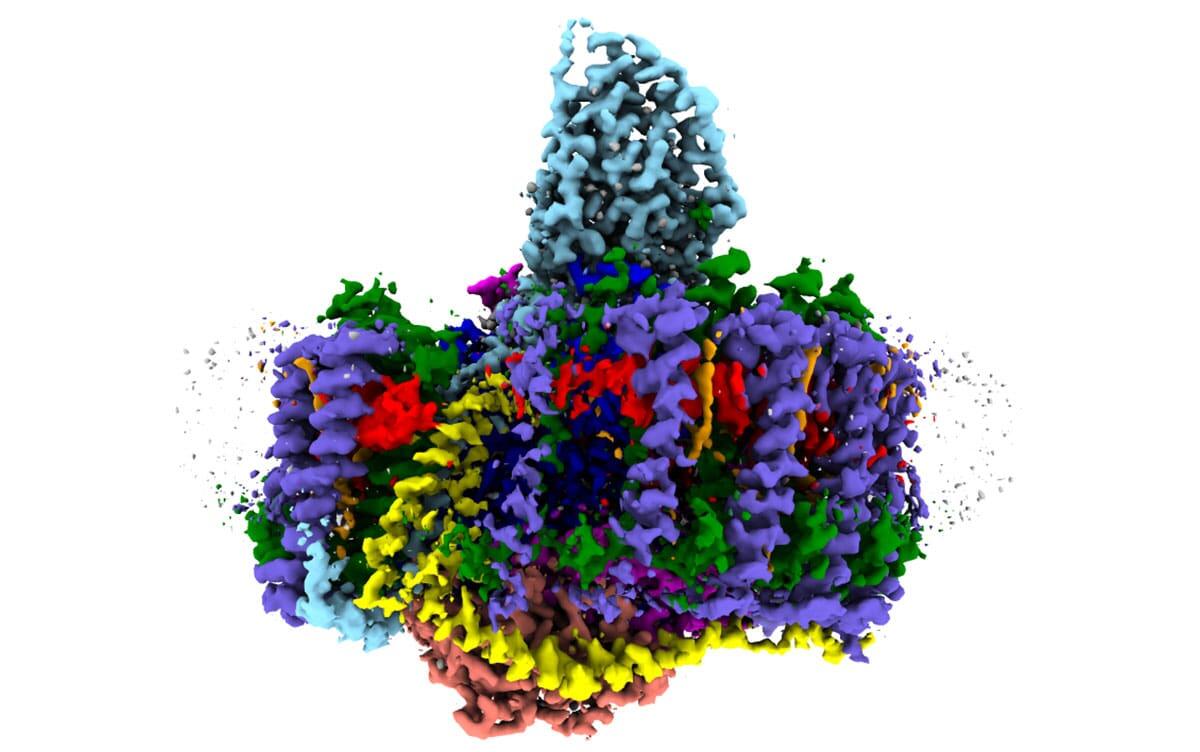
Oxygen is generally harmful to many photosynthetic bacteria; however, certain marine purple nonsulfur bacteria can grow even under oxic conditions. Researchers at University of Tsukuba used cryo-electron microscopy to visualize the structure of the protein complex responsible for photosynthesis in one such bacterium, Rhodovulum sulfidophilum. Their analysis uncovered a previously unrecognized membrane protein and revealed structural features that could explain how this organism achieves efficient energy conversion despite the presence of oxygen.
Tsukuba, Japan—Photosynthetic bacteria do not release oxygen during photosynthesis but can convert solar energy into chemical energy with remarkably high efficiency. They also utilize near-infrared light—wavelengths unused by plants—and thrive in diverse environments, including freshwater, seawater, and hot springs. Among these organisms, the marine purple nonsulfur bacterium Rhodovulum sulfidophilum is a model species notable for its strong tolerance to oxygen. However, the molecular mechanism by which its light-harvesting and energy-converting LH1-RC complex maintains highly efficient photosynthesis under oxic conditions remains unclear.
In this study, the researchers determined the structure of the LH1-RC complex at an exceptionally high resolution of 1.8 Å using cryo-EM. Their analysis identified a previously unknown membrane protein called protein‑3h, which is located within the LH1 opening. They further discovered a non-heme Fe ion positioned near the triheme cytochrome subunit, which is coordinated by a histidine residue and water molecules rather than by heme. This configuration indicates that the Fe ion might act as an intermediary site for electron transfer.
These findings provide deeper insight into the photosynthetic complex in R. sulfidophilum and could contribute to future applications, such as genetically engineered phototrophic systems and environmentally relevant technologies, including the bioremediation of hydrogen sulfide-containing wastewater.
###
This research was partially supported by the National Key R&D Program of China (No. 2022YFC3401800), Platform Project for Supporting Drug Discovery and Life Science Research (Basis for Supporting Innovative Drug Discovery and Life Science Research (BINDS)) from AMED under Grant Numbers JP21am0101118 and JP21am0101116, and JP23ama121004. R.K., E.R.P., T. M. and B.M.H. acknowledge the generous supports of Dr. Malgorzata Hall, the Okinawa Institute of Science and Technology (OIST), Scientific Computing & Data Analysis Section and Scientific Imaging Section at OIST and the Japanese Cabinet Office. R.K. acknowledges the support from Prof. Tsumoru Shintake. M.T.M. was supported in part by NASA Cooperative Agreement 80NSSC21M0355. This work was supported in part by JSPS KAKENHI (Grant Numbers 22K06111, 23K05822, 24H02084, 24K01620 and 24H02078), Center for Quantum and Information Life Sciences, University of Tsukuba, and MEXT Joint Usage/Research Promotion Project: CURE JPMXP1323015488 (Spin-L program No spin25XN018).
Original Paper
- Title of original paper:
- Structural insights into the photochemistry of the LH1-RC complex from the marine purple phototrophic bacterium Rhodovulum sulfidophilum
- Journal:
- Communications Biology
- DOI:
- 10.1038/s42003-026-09755-z
Correspondence
Professor TANI Kazutoshi
Center for Computational Sciences, University of Tsukuba
Professor Zheng-Yu Wang-Otomo
Faculty of Science, Ibaraki University
Professor KIMURA Yukihiro
Department of Agrobioscience, Graduate School of Agriculture, Kobe University
Associate Professor MINO Hiroyuki
Department of Physics, Graduate School of Science, Nagoya University
Section Leader MOCHIZUKI Toshiaki
Scientific Imaging Section, Core Facilities, Okinawa Institute of Science and Technology
Graduate University (OIST)
Related Link
Center for Computational Sciences


