


Research News
Cryo-EM Reveals the Structural Basis of Functional Diversity in Alcohol Oxidase Isozymes
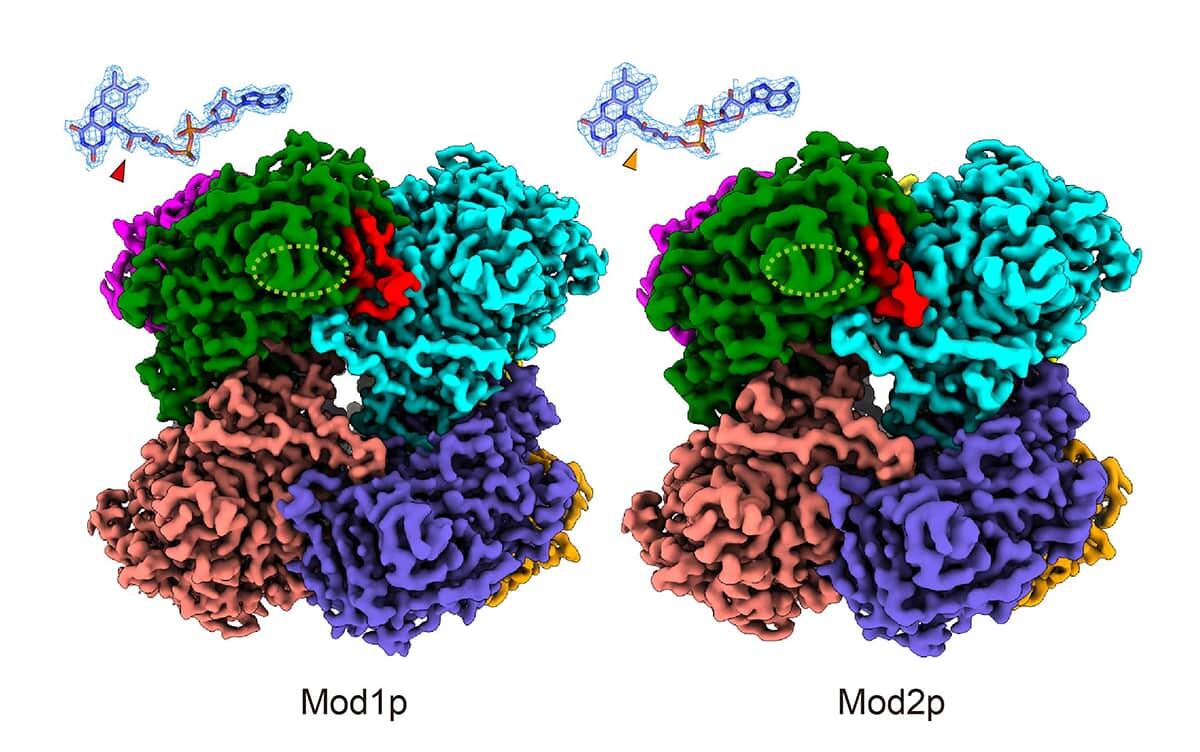 provided by Kazutoshi Tani
As the global push toward a carbon-neutral society accelerates, understanding how microorganisms metabolize methanol with high efficiency has become increasingly critical. At University of Tsukuba, researchers have applied cryo-electron microscopy (cryo-EM) to resolve the high resolution three-dimensional structure of a key methanol metabolizing enzyme in yeast. Their work reveals that enzymes with nearly identical overall architectures can nonetheless perform distinct functions depending on environmental conditions.
Tsukuba, Japan—Methanol is emerging as a promising feedstock for sustainable bioprocesses. To uncover the molecular basis of efficient methanol utilization, the researchers investigated alcohol oxidase (AOD), a central enzyme in the methanol-assimilating yeast Ogataea methanolica. Using cryo-electron microscopy (cryo-EM), they characterized structural and functional differences among AOD isozymes. This yeast produces multiple AOD variants that catalyze the oxidation of methanol to formaldehyde, the first step in energy metabolism. The coordinated activity of these isozymes allows the organism to adapt flexibly to changing environmental conditions, yet until now the structural foundation for their distinct roles had remained unclear.
In this work, the researchers carried out a comprehensive comparison of the three-dimensional structures of AOD isozymes. While the enzymes share a strikingly similar overall framework, clear distinctions emerged in how they bind cofactors and in the positioning of amino acid residues around the active site. Notably, differences were detected in the interaction with flavin adenine dinucleotide cofactors and in local surface charge distributions. These structural variations are likely to affect enzyme stability and electron transfer processes, ultimately resulting in differences in catalytic performance. Additional differences at the protein periphery were shown to contribute to the stabilization of oligomeric assemblies. Taken together, the findings highlight how even minor structural changes can drive substantial functional diversification among closely related enzymes. This work deepens our understanding of the molecular basis of enzyme function and provides a foundation for designing more efficient biocatalysts, as well as advancing microbial and enzymatic processes for sustainable methanol-based production.
###
This research was partially supported by the Platform Project for Supporting Drug Discovery and Life Science Research (Basis for Supporting Innovative Drug Discovery and Life Science Research) from AMED (Grant Numbers; JP21am0101118, JP22ama121006 and JP25ama121004), and JST-Mirai Program2 (Grant Number JPMJMI23G2). This work is also partly supported by a KAKENHI, Grant-in- Aid for Challenging Exploratory Research (18K19875) to T.N. from the Japan Society for the Promotion of Science (JSPS). This work is partly supported by Center for Quantum and Information Life Sciences, University of Tsukuba.
Original Paper
- Title of original paper:
- Cryo-EM structures of alcohol oxidase isozymes reveal structural determinants of cofactor variation and enzymatic activity in Ogataea methanolica
- Journal:
- Microbial Biotechnology
- DOI:
- 10.1111/1751-7915.70355
Correspondence
Professor TANI Kazutoshi
Center for Computational Sciences, University of Tsukuba
Professor NAKAGAWA Tomoyuki
Faculty of Applied Biological Sciences, Gifu University
Group Director/Professor YONEKURA Koji
Biostructural Mechanism Group, RIKEN SPring-8 Center / Institute of Multidisciplinary Research for Advanced Materials, Tohoku University
Related Link
Center for Computational Sciences

