


Research News
Vertical Vortices Generated by Flutter Kicking Contribute to Propulsion and Body Stabilization
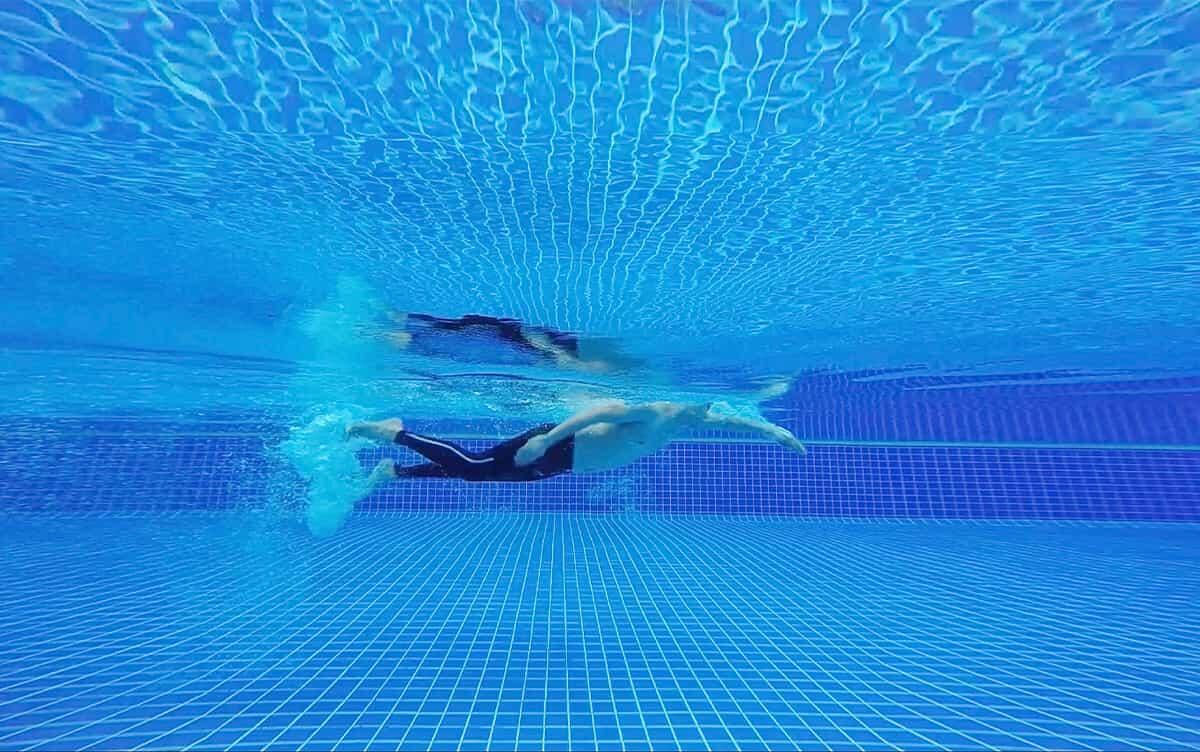 Image by Poh Smith/Shutterstock
Researchers at University of Tsukuba used advanced techniques to visualize the water flow generated by flutter kicking during front-crawl swimming. They analyzed how this kicking motion generates propulsive force and contributes to body stabilization, demonstrating that the vertical vortices resulting from the alternating left and right leg movements not only impart forward propulsion but also suppress body sway. These results provide a fluid‑dynamical explanation of the functional value of the flutter kick.
Tsukuba, Japan—In competitive swimming, both upper- and lower‑limb motions play important roles in propulsion. Extensive research has focused on the dolphin kick used in the butterfly stroke, revealing that this kicking technique generates three‑dimensional vortex structures that contribute directly to propulsion. In contrast, the propulsion mechanism of the flutter kick used in front crawl has remained poorly understood, largely because the alternating motion of the left and right legs induces complex flow patterns. Therefore, in this study, the researchers investigated the flow fields generated by the flutter kick by combining a motion-capture system with particle image velocimetry—an optical method for visualizing and measuring flow.
The results revealed that the flutter kick generates three‑dimensional vortices through leg motion that contribute to forward propulsion, similarly to the dolphin kick. However, in contrast to the dolphin kick, vertical flows are generated in opposite directions by the alternating left-right leg movements in flutter kicking. These vertical flows do not completely cancel out, resulting in a relatively strong net downward vertical flow, which in turn generates an upward force acting on the swimmer's body. Furthermore, flutter kicking produces asymmetric vortices in the frontal plane, generating rolling and yaw moments that act on the body. These moments can play an important role in stabilizing body posture during swimming.
Overall, the findings provide the first experimental evidence, based on direct flow‑field measurements, of the propulsion and stabilization mechanisms of the flutter kick. The results help improve the scientific understanding of the front-crawl technique and may support the development of more effective coaching and training methods.
###
This work was supported by Japan Science and Technology Agency, Grant Number 24K14474.
Original Paper
- Title of original paper:
- Flow-Field Analysis of the Underwater Flutter Kick Using Particle Image Velocimetry: Comparison with the Dolphin Kick
- Journal:
- Physics of Fluids
- DOI:
- 10.1063/5.0326069
Correspondence
Junior Assistant Professor NAKAZONO Yusaku
Institute of Health and Sport Sciences, University of Tsukuba
Associate Professor SHIMOJO Hirofumi
Department of Health and Sports, Faculty of Health Sciences, Niigata University of Health and Welfare
Professor SAKAKIBARA Jun
Department of Mechanical Engineering, School of Science and Technology, Meiji University
Related Link
Institute of Health and Sport Sciences


