


Research News
Genetic Analyses Reveal the Taxonomic Identity and Glacial Relict History of Betula costata in Japan
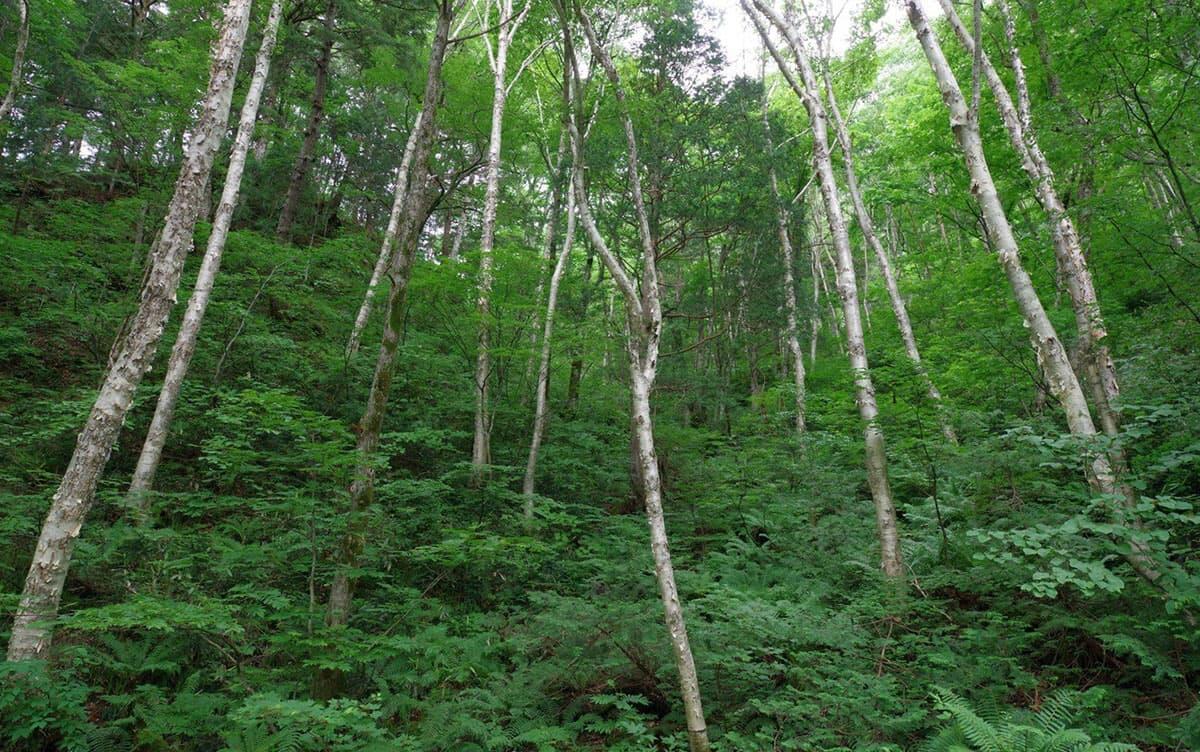 Provided by Takaki Aihara
Researchers at University of Tsukuba have found that Betula costata, a birch species recently discovered at several locations in central Japan, is phylogenetically indistinguishable from populations on the Asian continent. The species is thought to have been widely distributed throughout the Japanese Archipelago during the Last Glacial Maximum, with its range subsequently contracting as the climate warmed. The study also identifies clear diagnostic characteristics that distinguish B. costata from its closely related species, Betula ermanii.
Tsukuba, Japan—In recent years, several populations of the deciduous tree Betula costata have been identified in central Japan. Since this species is morphologically similar to closely related taxa, particularly Betula ermanii, its presence remained unrecognized for a long time. Accordingly, B. costata is now regarded as a relict species that provides important insights into the historical development of cool-temperate forests in the Japanese Archipelago. However, species delimitation within the genus Betula is notoriously difficult because of frequent interspecific hybridization and substantial intraspecific variation. Individuals previously regarded as belonging to a single species are often reassigned to another species on the basis of genetic evidence. Molecular approaches have become essential for accurate taxonomic identification. Furthermore, population genetic analyses enable researchers to reconstruct how isolated populations in Japan diverged from their continental counterparts and established their current distribution.
In this study, researchers analyzed phylogenetic relationships, genetic diversity, and population differentiation among Betula costata populations from China and among 13 populations identified in Japan. Using genome-wide single nucleotide polymorphism (SNP) data obtained through restriction site-associated DNA sequencing (RAD-seq), they inferred the evolutionary history of the Japanese populations. Phylogenetic analyses consistently placed Japanese individuals within the same clade as continental B. costata, supporting their classification as this species. Population genetic analyses further revealed extremely low genetic differentiation among Japanese populations, together with evidence of a past population bottleneck and subsequent decline. Taken together, these results are consistent with the hypothesis that B. costata was once widely distributed throughout Japan during the Last Glacial Maximum but subsequently experienced range contraction.
In addition, morphological analyses and ploidy estimation using flow cytometry demonstrated that B. costata can be clearly distinguished from B. ermanii. Notably, the number of leaf veins (13-16 in B. costata versus 11-13 in B. ermanii) and differences in ploidy level (diploid in B. costata versus typically tetraploid in B. ermanii) provide reliable diagnostic characteristics.
Overall, these findings suggest that Betula costata is more widely distributed throughout the Japanese Archipelago than previously recognized and represents an important component of cool-temperate forest ecosystems. The present study contributes to a better understanding of the processes underlying the formation of these forests, clarifies the species' distribution, and provides a foundation for future ecological and conservation research.
###
This work was supported by the JSPS KAKENHI program (grant no. 24H00055) and the Minami-Alps Society research Grant 2024.
Original Paper
- Title of original paper:
- Phylogenetic and population genetic analysis decipher the taxonomic consistency of cryptic Betula costata Trautv. (Betulaceae) populations in Japan and the process of its divergence and isolation
- Journal:
- Plant Species Biology
- DOI:
- 10.1111/1442-1984.70057
Correspondence
Researcher AIHARA Takaki
Institute of Life and Environmental Sciences, University of Tsukuba
Senior Researcher SHITARA Takuto
Tama Forest Science Garden, Forestry, and Forest Products Research Institute
Related Link
Institute of Life and Environmental Sciences
