


Research News
Bedding Structure Controls Rainfall Runoff in Mountain Catchments
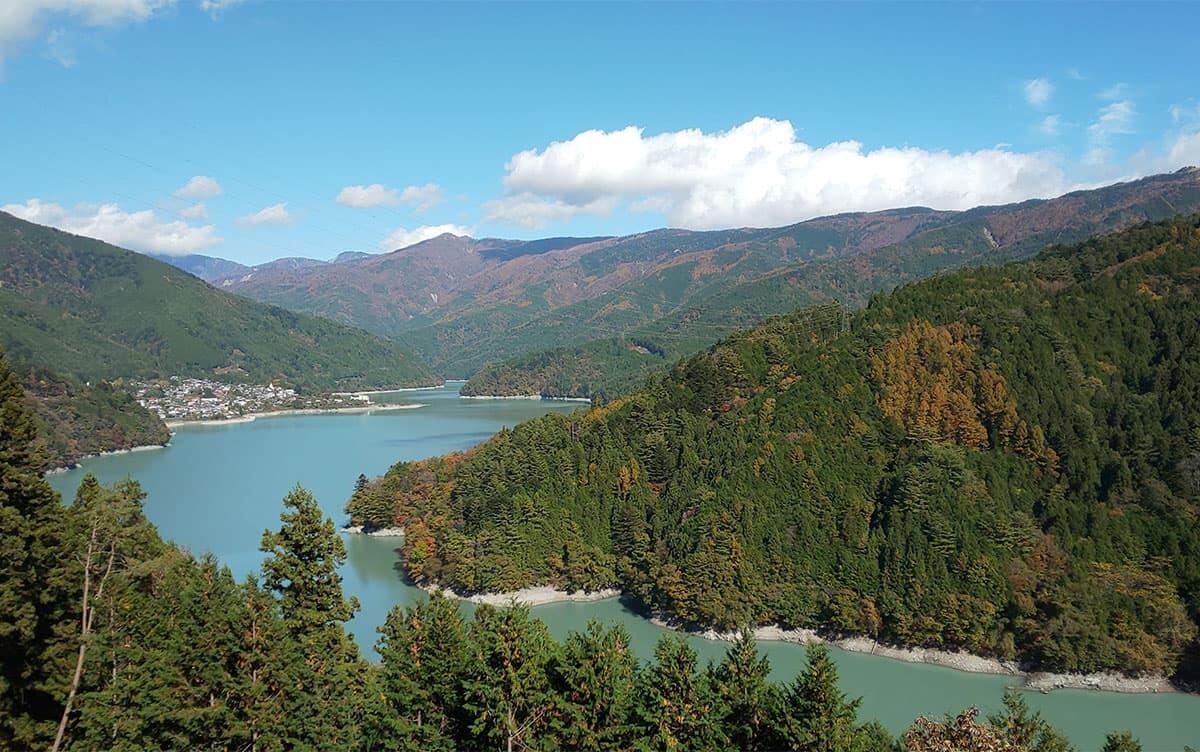 Provided by YAMAKAWA Yosuke
Researchers at University of Tsukuba have discovered that rainwater runoff in the highly rugged sedimentary rock mountains of Japan's Southern Alps is governed by two processes: "deep infiltration" and "shallow drainage via landslides." These processes are dictated by the inclination of geological strata. Based on these findings, the researchers propose a conceptual framework, termed the "structural ground system," to explain how the bedding structure regulates rainwater runoff.
Tsukuba, Japan—Accurately predicting large-scale landslides requires a thorough understanding of rainwater runoff in mountainous regions. The inclination of geological strata has long been suspected to influence subsurface water movement in sedimentary mountain ranges. However, direct observations at the mesoscale (catchment areas of approximately 0.1-10 km²), where many sediment-related disasters occur, have been challenging, leaving important aspects of these processes poorly understood.
To clarify the relationship between stratum inclination and water movement, researchers conducted simultaneous multisite observations of river discharge and water quality (electrical conductivity) during rainless periods across multiple campaigns. The study encompassed 16 adjacent watersheds in the upper Oi River basin of Japan's Southern Alps (Shizuoka Prefecture).
The analysis revealed that when the dip angle of the strata exceeds the topographic slope, rainwater infiltrates deep into the subsurface through fractures aligned with bedding planes, regardless of slope orientation. Consequently, spatial variability in baseflow discharge is relatively small in these areas.
By contrast, on dip slopes, where the bedding dip direction aligns with the slope aspect, landslide landforms tend to develop. In these regions, rainwater rapidly and dynamically drains from the shallow subsurface through fracture networks within landslide bodies after rainfall events. These results indicate that watersheds dominated by dip slopes possess a reduced water storage capacity while exhibiting greater temporal variability in runoff.
Integrating these mechanisms, the researchers developed a comprehensive model describing how geological structure controls rainwater behavior. They proposed this model as a new framework, the "structural ground system."
These findings are expected to improve the prediction of sediment-related disasters and may be applicable to other humid, tectonically active regions worldwide that share similar geological and geomorphological conditions.
###
This work was supported by the Japan Society for the Promotion of Science (JSPS), Grant/Award
Numbers: JP19H02989, JP20H03019, JP23K26939.
Original Paper
- Title of original paper:
- Dual control of bedding structure on catchment hydrology: the interplay between direct bedding-parallel recharge and indirect landslide-driven drainage in steep accretionary complexes
- Journal:
- Catena
- DOI:
- 10.1016/j.catena.2026.110236
Correspondence
Assistant Professor YAMAKAWA Yosuke
Institute of Life and Environmental Sciences, University of Tsukuba
Related Link
Institute of Life and Environmental Sciences


