


Research News
Antarctic 12-m Terahertz Telescope Project to Uncover Hidden Galaxy Formation
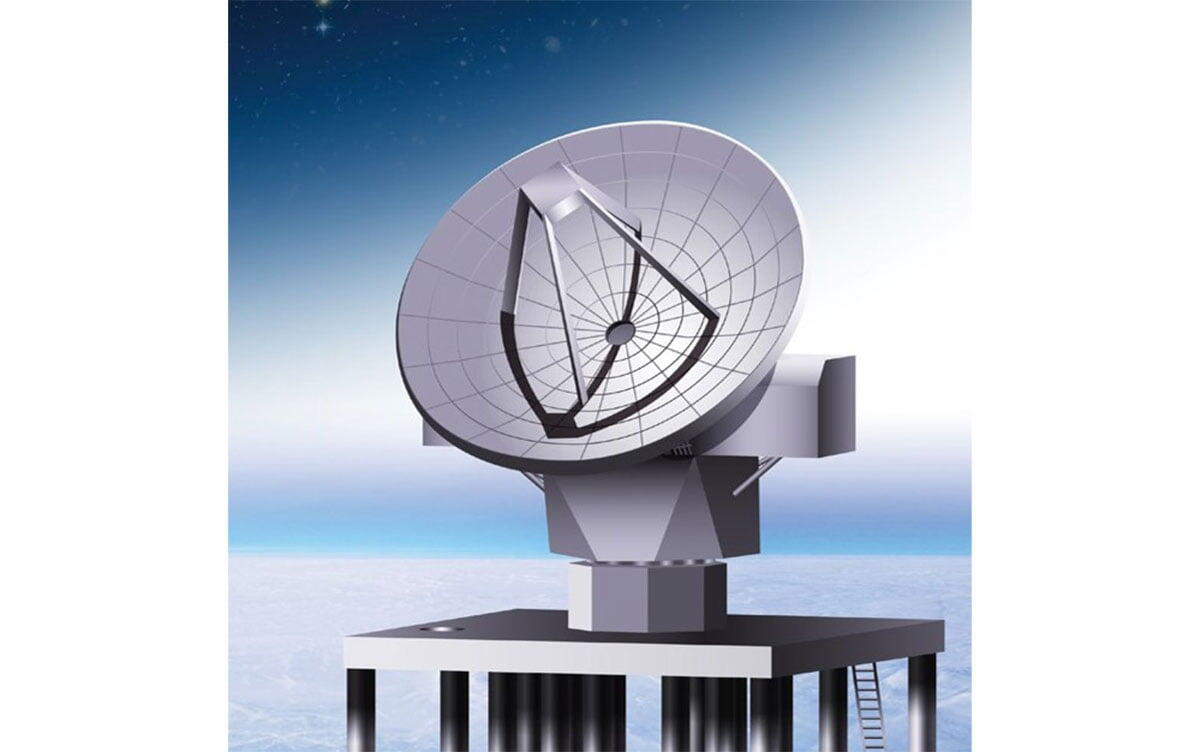
A new simulation study suggests that the Antarctic 12-m Terahertz Telescope (ATT12), a next-generation facility led by University of Tsukuba, could uncover between one and 10 million dusty star-forming galaxies throughout cosmic history. By utilizing Antarctica's exceptionally dry atmosphere, ATT12 is expected to open a new observational window into dust-obscured star formation, enabling astronomers to study galaxies from less than one billion years after the Big Bang to the peak epoch of galaxy formation.
Tsukuba, Japan—Although stars continuously form within galaxies, some galaxies contain vast amounts of dust that absorb and scatter starlight, obscuring their stellar populations and star formation at visible wavelengths. Understanding this dust-obscured star formation is crucial for revealing the formation and evolution of galaxies throughout the history of the universe.
In this study, the researchers performed a detailed assessment of the observational capabilities of the Antarctic 12-m Terahertz Telescope (ATT12). This telescope is planned for construction in the interior of Antarctica, a location with some of the lowest atmospheric water vapor levels on Earth. Because water vapor strongly absorbs far-infrared and terahertz radiation, its exceptionally dry conditions make Antarctica one of the world's premier sites for observations at these wavelengths.
Simulation results reveal that the wide-field multiband imaging cameras planned for ATT12 could detect distant galaxies that existed less than one billion years after the Big Bang. Surveys covering a large area of the southern sky could potentially identify between one and 10 million dusty star-forming galaxies difficult to detect with optical observations. Additionally, the study shows that the spectroscopic instruments for ATT12 will enable detailed investigations of galactic gas density and chemical composition via far-infrared emission line observations. These measurements are expected to provide new insights into galaxy evolution and the physical conditions within galaxies in the early universe.
This research demonstrates that ATT12 could play a major role in revealing the history of obscured star formation and the evolution of galaxies across cosmic time.
###
TH was supported by JSPS KAKENHI Grant Numbers 23K22529, 25K00020, and 25H00661. TH also appreciates support from NAOJ ALMA Scientific Research Grant Number 2025-28A. KM acknowledges financial support from the Japan Society for the Promotion of Science( JSPS) through KAKENHI Grant Number 20K14516. KM and TH were supported by JSPS KAKENHI Grant Number 22H01258. NK was supported by the Grant-in-Aid for JSPS Fellows ( 25H00661). HY was supported by MEXT/JSPS KAKENHI Grant Number 21H04489 and JST FOREST Program, Grant Number JP-MJFR202Z. MI was supported by the Grant- in-Aid for JSPS Fellows( 25KJ0670). YN was supported by MEXT/JSPS KAKENHI Grant Number 23K13140.
Original Paper
- Title of original paper:
- ATT12: The Antarctic 12-m Terahertz Telescope for Studies of Dusty Galaxies. I. Instrument Sensitivity and Science Forecasts
- Journal:
- Publications of the Astronomical Society of Japan (PASJ)
- DOI:
- 10.1093/pasj/psag048
Correspondence
Assistant Professor HASHIMOTO Takuya
Division of Physics, Institute of Pure and Applied Sciences, University of Tsukuba / TIAR Fellow of the Jihatsu Research Unit, Tsukuba Institute for Advanced Research (TIAR), University of Tsukuba
WAKASUGI Koki
Doctoral Program in Physics, Degree Programs in Pure and Applied Sciences, Graduate School of Science and Technology, University of Tsukuba
Professor SETA Masumichi
Department of Physics & Astronomy, School of Science, Kwansei Gakuin University
Associate Professor MATSUO Hiroshi
National Astronomical Observatory of Japan
Researcher MAWATARI Ken
Waseda Research Institute for Science and Engineering, Faculty of Science and Engineering, Waseda University
Associate Professor Dragan Salak
Astronomical Institute, Tohoku University
Related Link
Institute of Pure and Applied Sciences
Tsukuba Institute for Advanced Research (TIAR)

