


Research News
Dynamic Pitch Shifts in Vehicle Sounds Could Help Pedestrians Assess Collision Risk Earlier
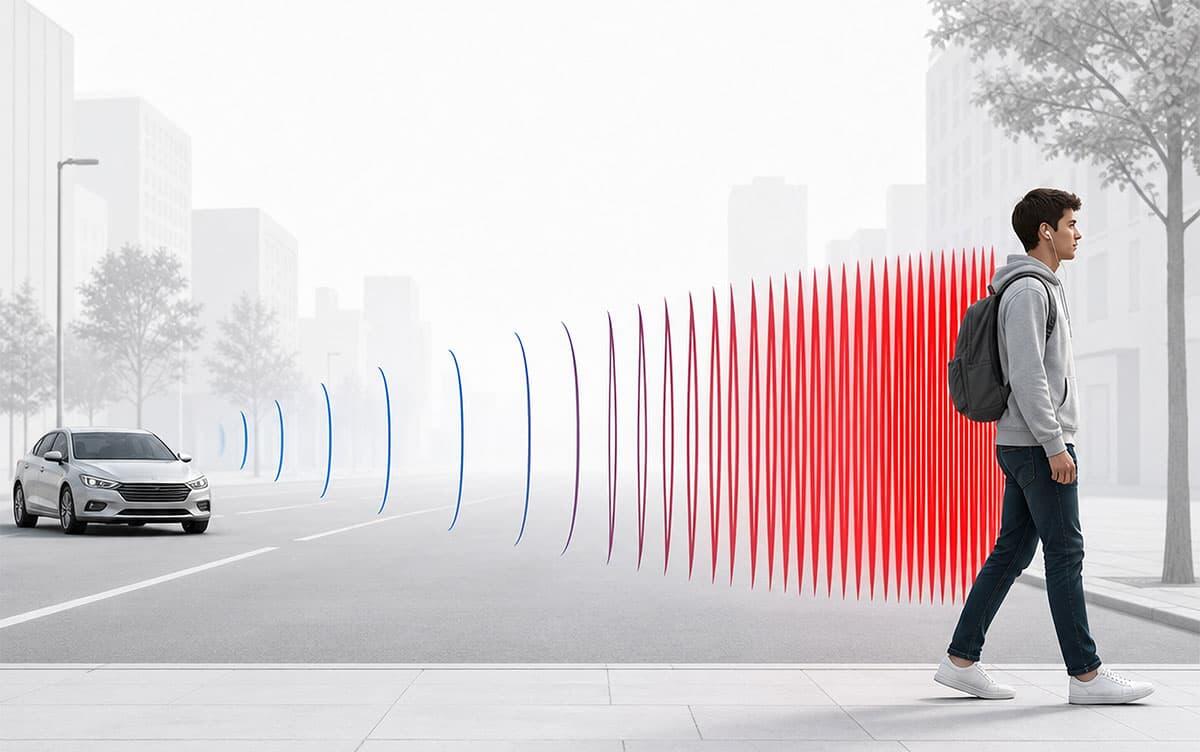 Image by Shutterstock AI Generator/Shutterstock
Researchers at University of Tsukuba have developed a method that dynamically increases the pitch of an approaching vehicle's sound as the time to collision decreases. In a controlled virtual reality study, participants judged the vehicle to be closer and moving faster than it actually was, thereby predicting an earlier collision. Because the method modifies the existing vehicle sound rather than adding a separate alarm tone, it may offer a less intrusive way to support pedestrian situation awareness.
Tsukuba, Japan—To improve pedestrian safety in urban areas, researchers are developing technologies that alert pedestrians to potential hazards via smartphones or earbuds. However, loud warning sounds and strong vibrations can be stress-inducing, and repeated alerts may eventually be ignored. To address this challenge, the researchers proposed a method that uses auditory augmented reality, which overlays information onto environmental sounds through earbuds, to slightly modify the sound of an approaching vehicle and naturally draw attention to the vehicle.
Human hearing perceives approaching sound sources based on multiple cues, such as an increase in loudness and a frequency increase (pitch). Changes in frequency are particularly effective for distant sound sources that are difficult to judge by loudness alone. Using this mechanism, the researchers investigated how pedestrians perceive a vehicle's speed, distance, and time to collision by artificially increasing the frequency of the vehicle's sound as it approaches.
The researchers conducted an experiment in a virtual reality urban environment with 30 participants. As the frequency shift increased, participants judged the vehicle as moving faster and closer than it actually was, and predicted an earlier collision. Furthermore, with target upward frequency-scaling ratios of up to 3×, realism ratings remained comparable to those for unmodified vehicle sounds in most conditions. This may reflect a learned association between higher-pitched vehicle sounds and higher vehicle speeds.
These findings suggest that dynamically shifting a vehicle's sound frequency could offer a less intrusive way to draw pedestrian attention to approaching vehicles, without requiring a separate alarm tone.
###
This work was supported by JSPS KAKENHI Grant Number 24H00892.
Original Paper
- Title of original paper:
- Modulating Auditory Looming Perception via Dynamic Frequency Shifting to Enhance Pedestrian Situation Awareness
- Journal:
- IEEE Access
- DOI:
- 10.1109/ACCESS.2026.3706113
Correspondence
Associate Professor ZEMPO Keiichi
Institute of Systems and Information Engineering, University of Tsukuba
Related Link
Institute of Systems and Information Engineering


