


Research News
3D Imaging and Machine Learning Improve Noncontact Weight Estimation of Frozen Skipjack Tuna
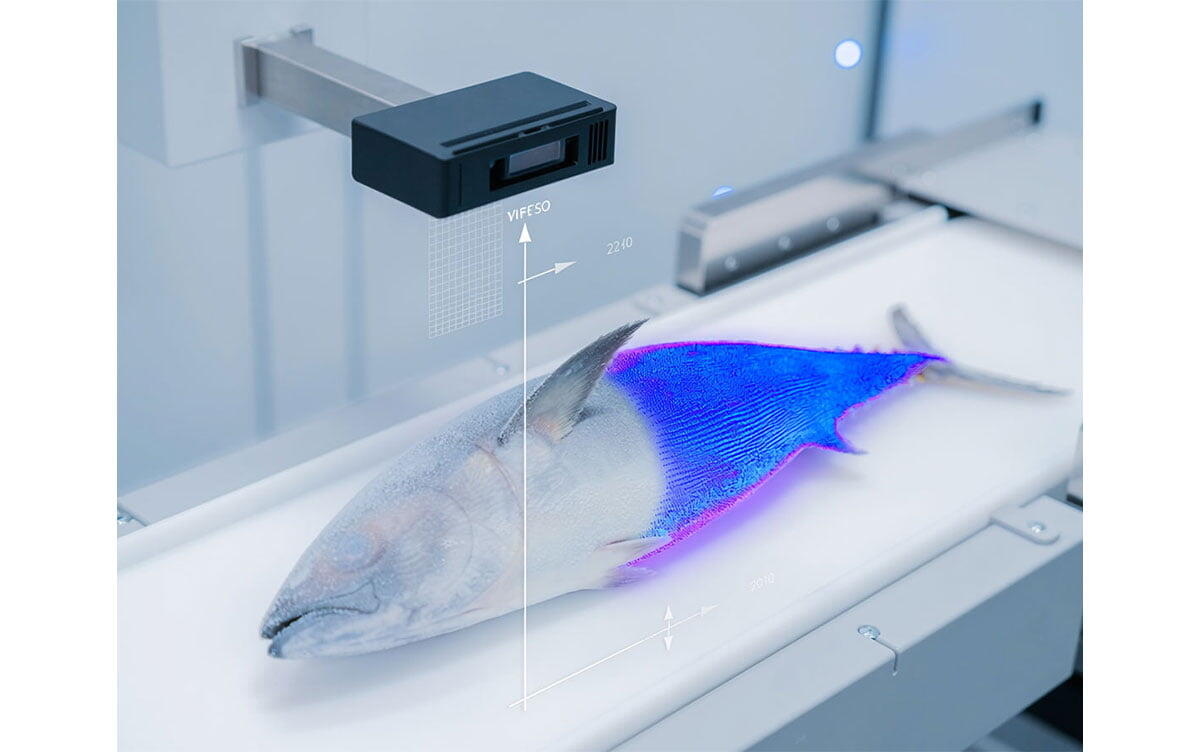
A joint research team, including researchers from University of Tsukuba, Ishida Tec Co., Ltd., and Tokyo University of Marine Science and Technology, has demonstrated a noncontact method for estimating the body weight of frozen skipjack tuna by combining three-dimensional (3D) time-of-flight imaging with machine learning. In a proof-of-concept study involving 207 frozen skipjack tuna, the researchers acquired 3D point-cloud data on a conveyor belt and extracted fork length, body height, and body width. A random forest model using all three measurements estimated body weight with a mean absolute error of 0.20 kg for fish weighing up to 7 kg, and agreement with the measured weight classes reached 80.7%, compared with 73.9% for classifications made by experienced market graders.
Tsukuba, Japan—Accurately determining fish body size and weight is essential for fisheries resource management and seafood processing; however, measuring large quantities of fish is labor intensive and the results may vary among operators. Although camera-based methods that rely on two-dimensional image analysis have been developed, skipjack tuna caught in distant-water fisheries are typically frozen on board, and the frost that forms on their surfaces strongly reflects light, rendering accurate shape measurement difficult.
In this study, the researchers developed a system based on a three-dimensional (3D) time-of-flight camera to measure distance with reflected infrared light to acquire 3D scans of frozen skipjack tuna on a conveyor belt. The camera captures the surface of each fish as dense 3D point-cloud data, enabling accurate reconstruction of the contours of frost-covered fish. From these data, the researchers extracted body width, fork length, and body height. Body width is a morphometric parameter that has been difficult to obtain with conventional imaging methods, and its inclusion proved to be important for improving the accuracy of body-weight estimation. In this proof-of-concept study, the acquisition of the 3D point-cloud data was automated, whereas the morphometric parameters were manually extracted.
Combining these 3D measurements with machine-learning analysis yielded accurate, noncontact estimates of fish body weight, which agreed more closely with the measured weight classes than the classifications made by experienced market graders. These findings demonstrate the potential of 3D imaging for noncontact fish measurement and body-weight estimation. With further development toward automated operation, the technology could help reduce labor demands at fisheries and seafood-processing facilities while supporting more efficient and consistent management of marine resources.
###
This study was financially supported by the FY2025 Grant for Innovative Technology Creation under Next-Generation Industry-Related Projects (Grant No. Shizuoka Sangyo Foundation No. 95).
Original Paper
- Title of original paper:
- Non-contact 3D morphometrics and weight estimation of frozen skipjack tuna using time-of-flight point clouds on a conveyor belt
- Journal:
- Fisheries Research
- DOI:
- 10.1016/j.fishres.2026.107820
Correspondence
Associate Professor ZEMPO Keiichi
Institute of Systems and Information Engineering, University of Tsukuba
President ISHIDA Hisashi
Ishida Tec Co., Ltd.
Assistant Professor MIYAMOTO Ryusuke
Department of Marine Biosciences, Tokyo University of Marine Science and Technology
Related Link
Institute of Systems and Information Engineering