


Research News
Genomic Evidence Identifies the Origin of Goosegrass on Nishinoshima, a Newly Emerged Volcanic Island
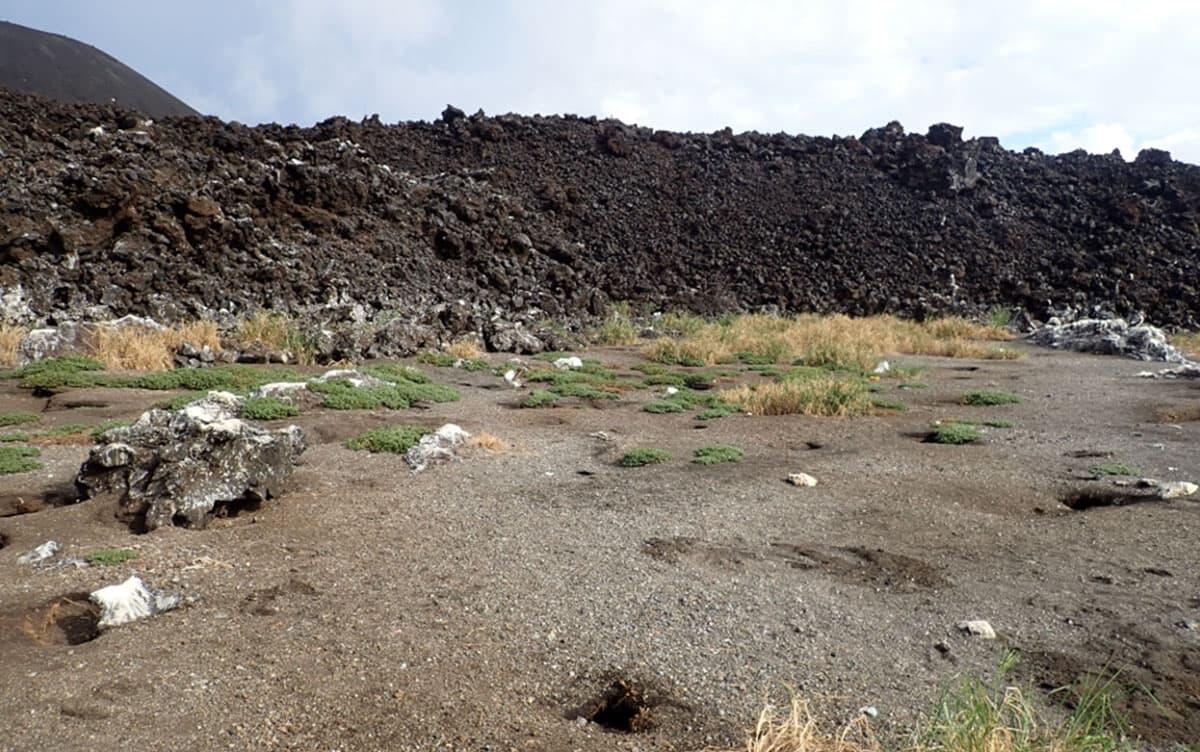
Researchers at University of Tsukuba analyzed the genetic makeup of Eleusine indica (goosegrass, known in Japan as "ohishiba") growing on Nishinoshima, a volcanic island located approximately 130-km northwest of Chichijima, Ogasawara Islands. Their findings suggest that the species most likely originated in tropical regions and reached Nishinoshima via Okinawa and the Ogasawara Islands via long-distance dispersal by seabirds. Their study provides rare evidence of plant colonization on newly formed oceanic islands and the development of ecosystems.
Tsukuba, Japan—Opportunities to directly observe how life colonizes newly formed land and how ecosystems subsequently develop are exceedingly rare. In this study, researchers used genetic analyses to investigate the origin of Eleusine indica, a grass species, found on Nishinoshima, an active volcanic island in the northwestern Pacific, south of mainland Japan. Having newly emerged, the island offers a unique natural laboratory for understanding the earliest stages of biological colonization and ecosystem development.
Since new land emerged during volcanic activity in 1973, Nishinoshima has been continuously expanding, yet only a small number of its plant species have been recorded. During a survey conducted in 2019, three plant species, including E. indica, were found surviving within a small, 0.5-ha remnant of the original island surface. Because human access to Nishinoshima is strictly restricted, how these plants established populations on such a remote oceanic island without human assistance was unknown.
The research team analyzed DNA samples of E. indica collected from Nishinoshima, mainland Japan, the Ogasawara Islands, the Ryukyu Islands, Indonesia, and other locations using advanced genetic techniques. The results indicated that the Nishinoshima population is most closely related to populations from the Ogasawara Islands, Okinawa, and Indonesia, suggesting dispersal from tropical regions through Okinawa and the Ogasawara Islands. Additionally, the analyses revealed extremely low genetic diversity within the Nishinoshima population, suggesting that it likely originated from a single seed or only a few seeds. Seabirds, including the brown booby (Sula leucogaster), commonly breed on and around Nishinoshima. Thus, the researchers propose that seeds were transported over long distances by birds and subsequently established on the island.
This study provides rare genetic evidence of how plants colonize newly formed volcanic islands and offers important insights into the earliest stages of ecosystem establishment in isolated oceanic environments. The findings also highlight the potential importance of seabirds in connecting distant island ecosystems via long-distance seed dispersal.
###
This paper was partly supported by the JSPS KAKENHI program (grant no. 24H00055).
Original Paper
- Title of original paper:
- Origin of the Eleusine indica population on the active volcanic Nishinoshima Island, Japan
- Journal:
- Journal of Plant Research
- DOI:
- 10.1007/s10265-026-01738-9
Correspondence
Professor Emeritus TSUMURA Yoshihiko
Professor KAMIJO Takashi
Institute of Life and Environmental Sciences, University of Tsukuba
Chief UCHIYAMA Kentaro
Tree Genetics Laboratory, Department of Forest Molecular Genetics and Biotechnology, Forestry and Forest Products Research Institute
Related Link
Institute of Life and Environmental Sciences
