


Research News
New AI Model Combines Physics and Observations to Reconstruct the History of the Earth's Mantle
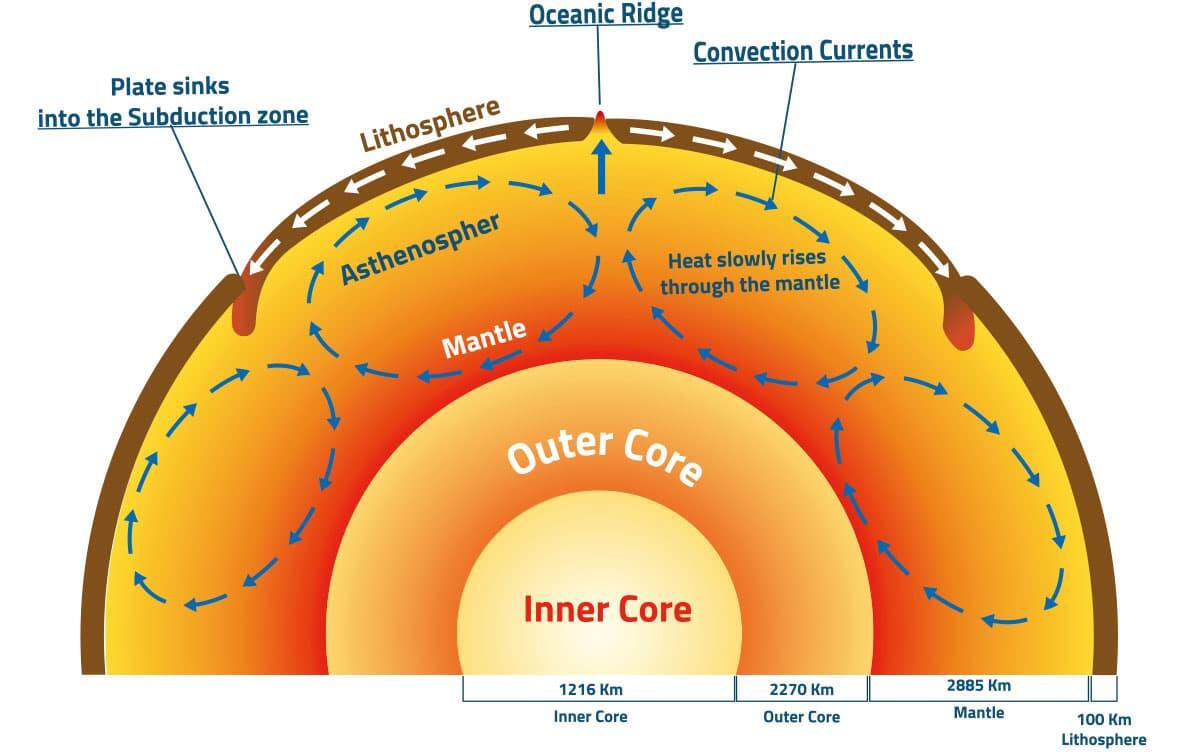 Image by sci-Media/Shutterstock
A researcher at University of Tsukuba has developed an artificial intelligence model that integrates observational data with the physical laws governing mantle convection. The approach may enable researchers to reconstruct past temperatures and flow patterns deep inside the Earth, which cannot be directly observed, using only limited information on the mantle motion near the Earth's surface and the present-day temperature distribution within the mantle. The model was validated by directly comparing the reconstructed mantle history from controlled numerical experiments with a known reference solution.
Tsukuba, Japan—The mantle, a rocky layer accounting for more than 80% of Earth's volume, circulates at rates of only a few centimeters per year. This circulation drives plate tectonics and influences major geological phenomena such as earthquakes and volcanic activity. Despite its fundamental importance, the history of mantle circulation remains poorly understood because direct observations of the deep Earth are extremely limited. Presently, scientists rely on geological records of past surface movements and geophysical imaging methods, including seismic observations, to infer the mantle's structure and behavior. However, reconstructing historic mantle flow remains a major challenge.
In this study, the researcher developed an AI model based on a physics-informed neural network. The model was trained not only to fit observational data but also to satisfy the physical equations that govern heat transport and fluid flow in the mantle. To test the model, the researcher first generated computer simulations of two-dimensional mantle thermal convection. The simulation results formed a reference solution against which the AI reconstruction was evaluated. The model was provided with synthetic observations representing near-surface mantle motion and a present-day snapshot of the mantle temperature distribution. Although information about past temperatures and deep-mantle flow was not supplied directly, the model successfully reconstructed these hidden features with high accuracy. The results indicate that combining complementary types of geophysical information is essential for recovering realistic mantle convection histories.
With further development and application to real geophysical data, this approach may provide a powerful tool for revealing how the Earth's deep interior has evolved over time.
###
This research was supported by JSPS KAKENHI Grant 25K00228 and Joint Research Programs of
the Earthquake Research Institute, University of Tokyo (2024‐B‐01 and 2025‐B‐01).
Original Paper
- Title of original paper:
- Physics-informed machine learning framework to retroactively estimate mantle thermal convection from partial geophysical observations
- Journal:
- Journal of Geophysical Research: Machine Learning and Computation
- DOI:
- 10.1029/2026JH001310
Correspondence
Assistant Professor NAKAO Atsushi
Institute of Systems and Information Engineering, University of Tsukuba
Related Link
Institute of Systems and Information Engineering
