


Research News
Posture-Supportive Environments Enhance How You Think and Play in Esports
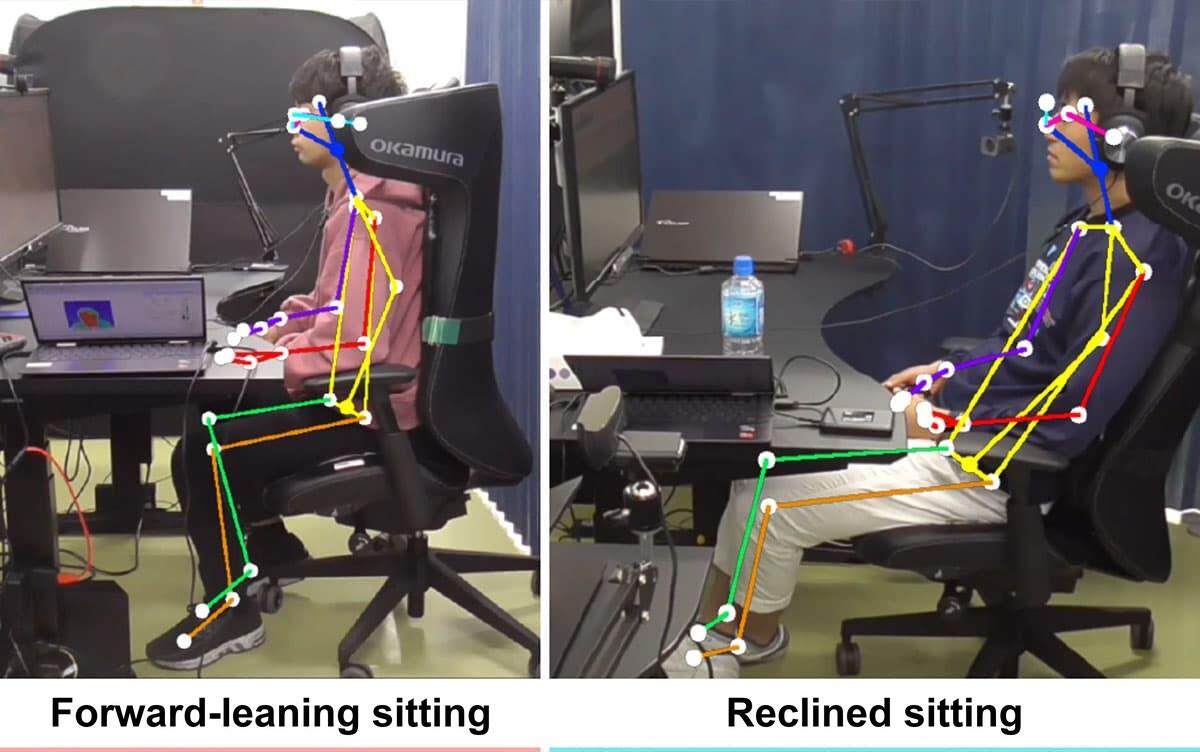
Standing and forward-leaning seating increased vitality and encouraged attacking play, while reclining helped preserve cognitive accuracy during longer sessions. Researchers at University of Tsukuba and OKAMURA CORPORATION demonstrated how desk and chair settings can shape cognitive and gaming performance—and how those effects change over time.
Tsukuba, Japan—Leaning forward was observed to encourage players to take more shots and make more passes in a soccer video game. Meanwhile, reclining helped them maintain accuracy in a cognitive task after three hours of gaming. These contrasting findings highlight the influence of an environment that supports a player's posture on both their gameplay and cognitive performance over time.
The study, published in Computers in Human Behavior Reports, examined 25 young adult male gamers. Using a height-adjustable desk and a chair with adjustable seat and backrest angles, the researchers compared standing with conventional sitting in 10 participants and forward-leaning with reclined sitting in 15 others. In both conditions, each participant played a soccer video game for up to three hours on separate days and in a randomized order.
Standing provided an early boost. Players felt more energized and, after 15 minutes, showed less interference from distracting information in a cognitive task than before play. They also took more attempts and achieved higher accuracy than during conventional seated play. By one hour, however, players experienced greater fatigue and interference from distractions than in the seated condition. From one hour onward, five of the ten participants felt fatigue or leg discomfort, which caused them to stop standing play.
With forward-leaning seating, players gained some of the benefits of standing while remaining seated. Compared with reclining, forward-leaning seating increased players' vitality and encouraged more shots and passes early in play. At one hour, players also displayed less interference from distractions after forward-leaning play than after reclined play, but after three hours, cognitive-task accuracy in the former condition was lower than at the start of play and lower than in the latter condition. No significant decline from baseline was observed with reclining.
The cognitive task measured players' executive function, that is, the ability to select an appropriate response while resisting distracting information. Specifically, participants identified the direction of a central arrow while ignoring surrounding arrows. All testing took place in the same standardized seated posture regardless of players' actual gaming posture.
Forward-leaning seating offered an active alternative to standing, while reclining showed promise for supporting cognitive endurance.
A practical takeaway here involves matching posture to the task and letting it change over time. Moving between more active and more relaxed postures allows players to balance short-term cognitive agility with sustained accuracy. However, research has yet to determine whether switching actually combines these benefits—and when or how often to switch. Beyond esports, this approach highlights adaptable desk and chair configurations that support cognitive performance and health during digital work and study.
###
This work was supported by a contract research grant from OKAMURA CORPORATION to T.M.; the Top Runners in Strategy of Transborder Advanced Researches (TRiSTAR) program, conducted as the Strategic Professional Development Program for Young Researchers by the Ministry of Education, Culture, Sports, Science and Technology (MEXT), to T.M.; and Fusion Oriented Research for disruptive Science and Technology (FOREST) of the Japan Science and Technology Agency to T.M. (JPMJFR205M).
Original Paper
- Title of original paper:
- Posture-Environment Design Promotes Executive Function and Gaming Performance during Esports Play
- Journal:
- Computers in Human Behavior Reports
- DOI:
- 10.1016/j.chbr.2026.101325
Correspondence
Associate Professor MATSUI Takashi
Institute of Health and Sport Sciences, University of Tsukuba
Haruyuki Asada
OKAMURA CORPORATION
Related Link
Institute of Health and Sport Sciences