


Research News
How Palm Orientation Shapes Spin Characteristics in Volleyball Jump Serves
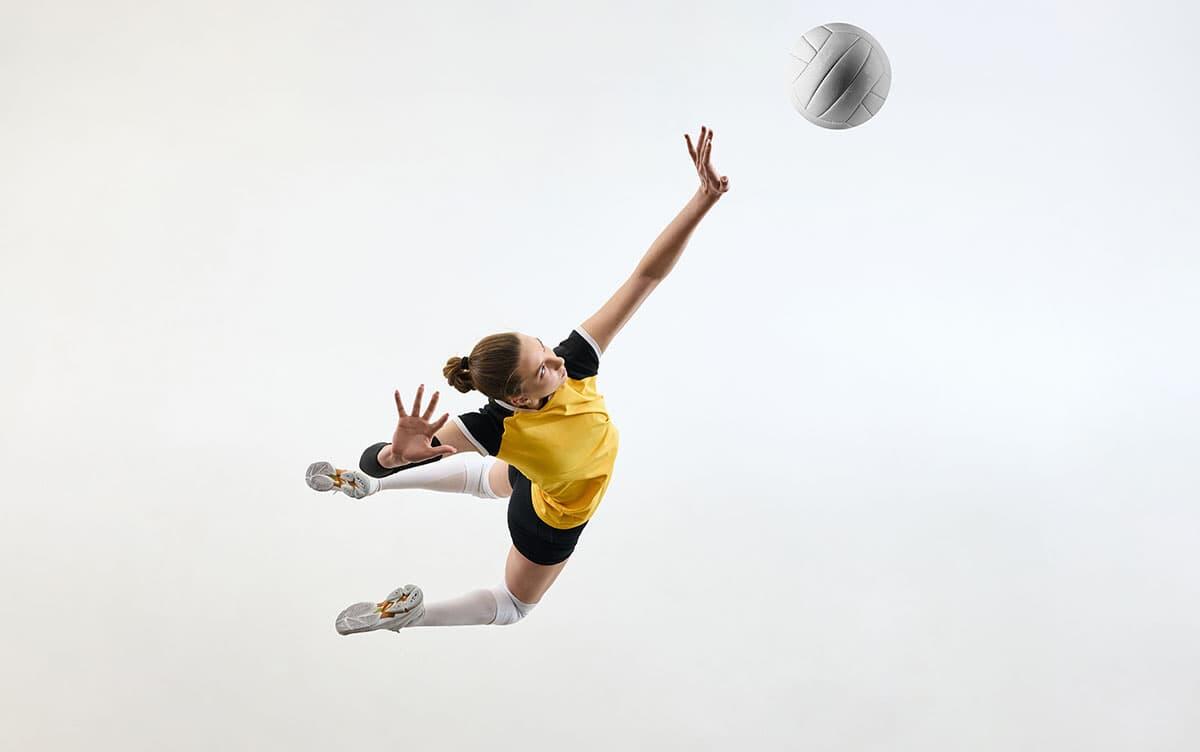 Image by Master1305/Shutterstock
Researchers at University of Tsukuba performed a three-dimensional motion analysis to investigate the relationship between ball spin and palmar orientation during jump serves in volleyball. The study analyzed the biomechanics of an elite, ex-Japanese national team female collegiate volleyball player. The findings revealed that variations in hand orientation at ball impact corresponded closely with the magnitude and direction of both topspin and sidespin imparted to the ball.
Tsukuba, Japan—A new biomechanical study has uncovered how elite volleyball players control ball spin during jump serves, offering fresh scientific insight into one of the sport's most decisive offensive skills. The jump serve is a major scoring weapon in modern volleyball that can rapidly shift match momentum. In particular, "hybrid" serves, which combine topspin and lateral spin, have gained increasing prominence at the highest levels of play. Despite their growing use, the biomechanics governing their execution have remained poorly understood.
In this study, a female collegiate athlete who played on the Japanese national team executed three types of serves—jump float, jump drive (topspin), and jump hybrid (side-spin)—under controlled laboratory conditions. Using a high-speed three-dimensional motion capture system, researchers precisely measured ball velocity, vertical and horizontal spin rates, and hand orientation at the moment of impact.
The results demonstrated clear systematic differences among serve types. Both jump drive and hybrid serves generated significantly greater topspin than the float serve. Strikingly, the hybrid serve generated significantly higher lateral spin, highlighting its distinct aerodynamic characteristics.
Crucially, hand orientation at impact was directly correlated with the resulting ball spin. A greater forward tilt of the palm (sagittal plane angle) increased topspin, while a greater sideways tilt (horizontal plane angle) increased lateral spin. Notably, the hybrid serve was characterized by a pronounced horizontal hand orientation, identifying a key biomechanical basis for its side-spin generation.
"These findings demonstrate that the spin in jump serves is not accidental, but rather the result of precise and controllable hand mechanics," the researchers noted.
Although based on a single highly skilled athlete and not intended for statistical generalization, the study is a rare, high-resolution visualization of elite-level serving technique. By quantifying the invisible aspects of athletic performance, the findings offer an empirical basis for data-driven coaching and individualized skill development.
The research is expected to not only enhance volleyball training methods but also expand the current understanding of spin generation and control in ball sports.
###
This study was partially supported by the Advanced Sports Medicine and Science Research Program of the Japan Sports Agency.
Original Paper
- Title of original paper:
- Kinematic Characteristics of Ball Spin Rate and Angle of Attack in Jump Serves Performed by an Elite Female Collegiate Volleyball Player
- Journal:
- The Japan Journal of Coaching Studies
- DOI:
- 10.24776/jcoaching.40.1_79
Correspondence
Associate Professor NAKANISHI Yasumi
Institute of Health and Sport Sciences, University of Tsukuba
Professor ASAI Takeshi
Faculty of Physical Education, International Pacific University
Related Link
Institute of Health and Sport Sciences
