


Research News
EEG Analysis Estimates Depressive Symptom Severity in Adults Not Receiving Psychiatric Treatment
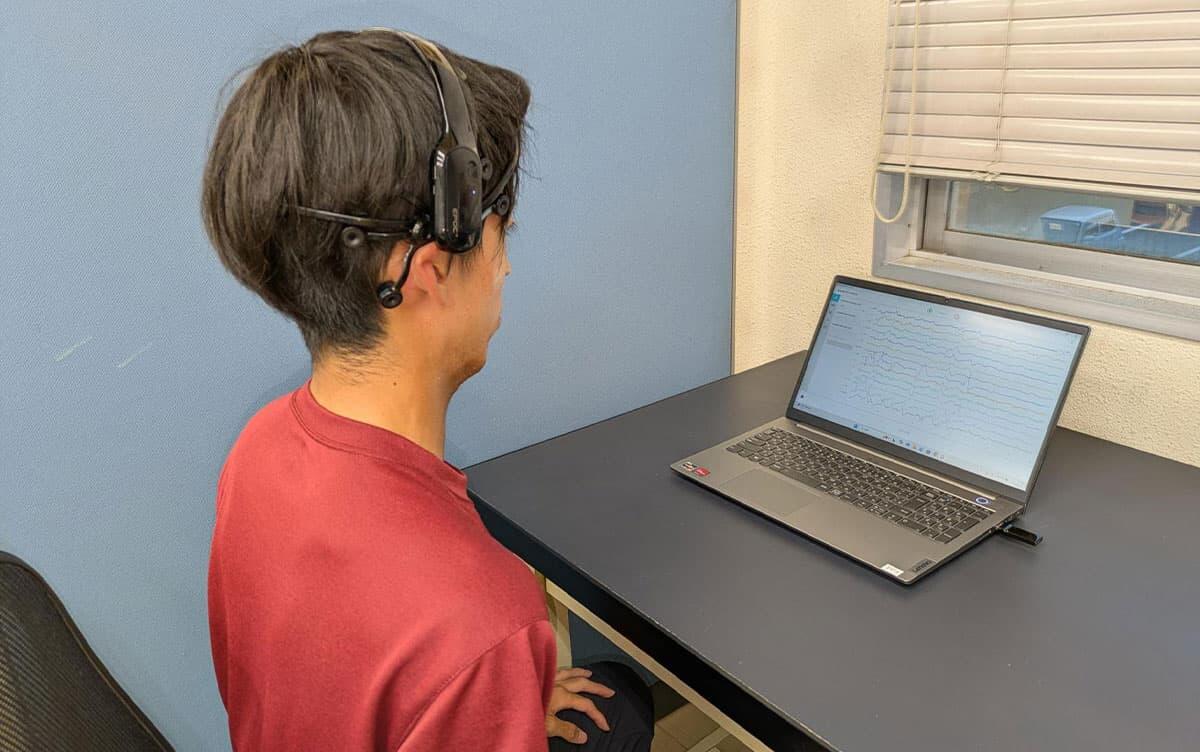 Provided by MORITA Masahiko
Researchers at University of Tsukuba have developed a method that uses brainwave patterns to estimate the severity of self-reported depressive symptoms in adults who are not receiving treatment. The method examines how abrupt timing shifts in brain rhythms at one recording site are associated with those at another, and could support future screening and symptom monitoring.
Tsukuba, Japan—Recognizing depressive symptoms early is important for connecting people with support and treatment, but severity is still assessed mainly through self-reports and interviews. Electroencephalography (EEG) is an accessible, noninvasive way to record brain activity, yet estimating severity across a broad range of untreated individuals remains challenging.
Using a 14-channel portable headset, the researchers recorded resting-state EEG data from 276 adults aged 18-59 years who received no psychiatric treatment or psychotropic medication in the previous year. Symptoms were assessed using the 20-item Zung Self-Rating Depression Scale.
The research team focused on phase resetting, which refers to an abrupt shift in the timing of rhythmic brain activity. Their earlier work linked the frequency of phase-resetting events with day-to-day changes in depressive mood within individuals. However, individual differences made this measure difficult to use for comparing symptom severity between individuals. In this new study, the researchers introduced phase-resetting rate modulation (PRRM), which characterizes how the likelihood of a phase-resetting event at one recording site changes following an event at another. Although only a weak association was observed between PRRM values for individual pairs of recording sites and symptom severity, averaging selected PRRM-based features into a single index yielded a much stronger association.
During cross-validation, each participant's score was predicted using a model built using other participants' data. EEG-based estimates were correlated with questionnaire scores, with a correlation coefficient greater than 0.6. Furthermore, the method distinguished 116 participants with moderate-to-severe symptoms from 114 participants with low symptom levels, achieving approximately 80% accuracy (participants with mild symptoms were excluded from this comparison).
Unlike approaches that distinguish patients with diagnosed depression from healthy controls, this method addresses differences in severity among people not receiving treatment. The findings concern self-reported symptoms, not clinical diagnosis; validation in independent populations, including clinical assessments, is required before clinical use. With further development, this approach may support screening for depressive symptoms, assist clinical assessment, and help monitor symptom changes. The team plans to investigate whether higher-performance EEG devices can enhance accuracy and to collaborate with companies and medical institutions toward practical applications.
###
This work was supported by JSPS KAKENHI Grant Number 23K17457.
Original Paper
- Title of original paper:
- Distributed EEG phase-resetting dynamics predict depressive symptom severity in untreated adults
- Journal:
- Nature Mental Health
- DOI:
- 10.1038/s44220-026-00757-8
Correspondence
Professor MORITA Masahiko
Institute of Systems and Information Engineering, University of Tsukuba
Related Link
Institute of Systems and Information Engineering
