


TSUKUBA FRONTIER
#051 Capturing the Dynamics of Buildings through Structural Collapse: Simulations to Create Safer, Smarter Buildings
Professor ISOBE Daigoro, Institute of Systems and Information Engineering

Understanding how buildings collapse is essential for the safe planning of blast demolition of aging high-rise buildings and for designing structures that can withstand earthquakes and other natural disasters.
Our laboratory has developed original numerical methodologies and conducted extensive simulation studies to reproduce these complex processes. These techniques have been gradually adopted not only in architectural engineering but also in unexpected fields, such as robotic mechanism control.
Simulating Collapse Behaviors of Real Buildings

Buildings are constructed using components made of various materials and geometries, which are carefully designed and integrated to prevent failure. Therefore, the progression of a collapse largely depends on the structural configuration and the magnitude and direction of the applied forces.
Such behavior is commonly analyzed using the finite element method (FEM), a numerical tool that can also be applied to analyze automobiles, aircraft, and electronic equipment. FEM continues to evolve toward capturing the detailed characteristics of individual components, and we are working on further improvements that account for the properties of each component.
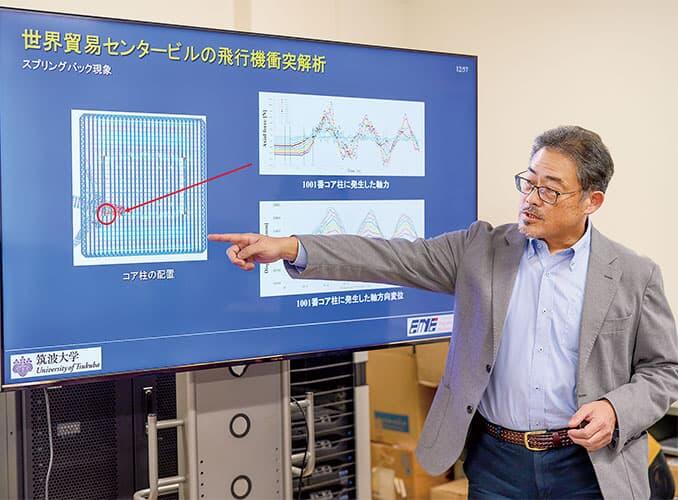
As an early application to real large-scale structural collapse, our technique was used to analyze the collapse of the World Trade Center towers in 2001, revealing structural vulnerabilities unique to high-rise buildings and highlighting that computational approaches provide valuable insights into catastrophic events.
Toward Improved Disaster Prevention and Mitigation
Gymnasiums often function as evacuation shelters during disasters; however, certain roof structures increase the risk of ceiling collapse during strong earthquakes.
Through detailed analyses, we revealed that forces concentrate in certain areas such as the corners of triangular roof systems, rendering them particularly susceptible to damage. To maintain safe, large-span spaces supported by a limited number of columns, ceilings and roofs (including their smaller components) must be modeled in detail.
During an earthquake, the interior of a building may be unsafe even if the overall structure is earthquake-resistant. Accordingly, we have analyzed the shaking and overturning of indoor furniture during earthquakes. When compared with experimentally induced shaking captured using motion-capture technology, the simulation results showed close agreement, demonstrating the limitations of simple earthquake‑resistant measures such as tension rods. We have also developed a virtual reality (VR) system that simulates these scenarios. Users experience this motion firsthand, gaining insights into reconsidering the placement and selection of furniture in their homes.
Beyond Simulation: Designing for Safety
While nobody wishes to witness a building collapse, understanding the failure mechanisms of buildings is important for improving structural designs and ensuring safe evacuation routes. High-rise buildings in Japan are designed to resist collapse; however, it remains important to understand how structures may be damaged or displaced by earthquakes and tsunamis.
As the number of buildings undergoing demolition due to aging or redevelopment increases, simulation-based analysis can also improve the safety and efficiency of demolition planning. These analyses include predicting the post-demolition debris distribution.
Nevertheless, these powerful techniques must be handled responsibly. To avoid misuse of collapse simulations that are carelessly released, we must carefully consider how the research results are disclosed.
Any Research Becomes an Asset
When I was a student, I was originally attracted to robotics. As the laboratory I hoped to join was unavailable, I instead pursued computational mechanics, where I encountered the FEM. The FEM was rapidly gaining attention in Japan at that time and has since become increasingly relevant to robotics research. Accurately modeling each component is essential for optimizing the overall motion of a robotic system, especially as more joints are incorporated. Whereas traditional robotics relies on complex calculations based on motor torque, FEM enables a more direct analysis of system dynamics based on the forces acting on materials and structures.
This cross-disciplinary perspective provided insights that could not have emerged from robotics alone and unexpectedly reconnected me with the field I had originally wanted to pursue.
Based on these experiences, I tell my students that even if their research field is not their initially chosen field, their efforts will eventually become valuable assets. Robotics is a strong research field at the University of Tsukuba and continues to grow.
Profile
He has extensively contributed to the development of impact-and-collapse analysis methods for building structures and analysis techniques for nonstructural components. He has been awarded the Ichimura Award and the Kawai Medal.
He has chaired numerous international conferences in computational mechanics and led programs promoting doctoral education in collaboration among academia, government, and industry. He served as the 14th president of the Japan Society for Computational Engineering and Science and is currently a member of the Board of Education, Ibaraki Prefecture.
His publications include Progressive Collapse Analysis of Structures: Numerical Codes and Applications.
(URL:https://www.kz.tsukuba.ac.jp/~isobe/)
Article by Science Communicator at the Bureau of Public Relations
TSUKUBA FRONTIER (PDF for printing)