


TSUKUBA FRONTIER
#053 Hydrogen Boride: A Promising Material for the Future
A New Material with the Potential to Transform Society
Professor KONDO Takahiro, Institute of Pure and Applied Sciences
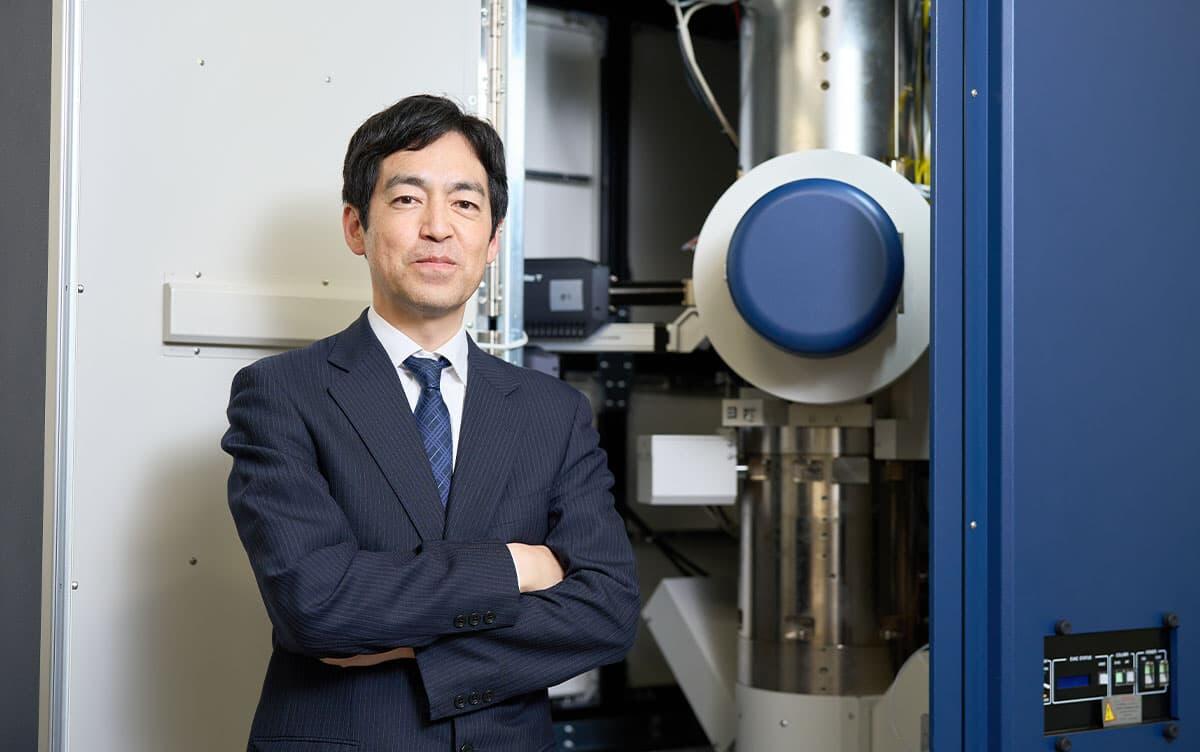
Hydrogen boride has the potential to play a key role in future energy technologies. My research team was the first to synthesize hydrogen boride nanosheets, paving the way for a wide range of applications extending beyond energy storage. To accelerate the development of practical applications, the University of Tsukuba recently established the Hydrogen Boride Research Center, where I serve as Director and lead interdisciplinary research projects.
"Hydrogen Boride: A Promising Hydrogen Storage Material"
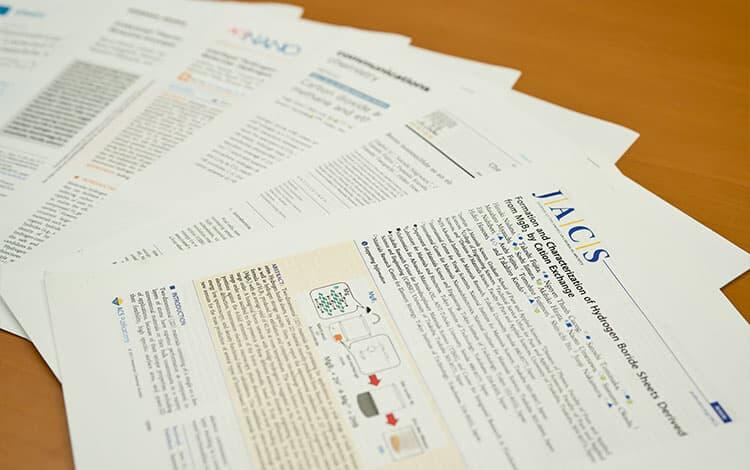
Boron and hydrogen can form various compounds, depending on how the atoms bond and combine. Hydrogen boride (HB) nanosheets, first synthesized in 2017, are composed of boron and hydrogen in a 1:1 atomic ratio.
Although HB appears to be a simple powder to the naked eye, electron microscopy reveals ultrathin two-dimensional sheets only one or two atomic layers thick. The boron atoms form a network, with hydrogen atoms incorporated into the structure, creating a unique nanoscale material.
One of the most attractive features of HB nanosheets is their ability to release hydrogen when heated. They are therefore considered a promising hydrogen storage material that could enable hydrogen to be stored safely and released on demand.
This potential application is particularly important because hydrogen is regarded as a promising clean energy carrier for technologies such as fuel cells. However, because hydrogen is lightweight, readily diffuses, and is highly flammable, its efficient transport and storage remain major challenges. To address these issues, we are investigating the detailed structure and physicochemical properties of HB nanosheets, with the aim of controlling and optimizing their performance as a hydrogen storage material.
Protecting Against Neutron Radiation
As our research progressed, we began to discover unexpected possibilities for HB beyond energy applications.
One particularly promising area is neutron shielding. Neutrons are a form of radiation that can affect human health, electronic devices, and digital data. Because boron and hydrogen can both contribute to effective neutron shielding, HB nanosheets may offer neutron-shielding capabilities without requiring the thick layers of conventional shielding materials used in some applications. As a result, these materials could potentially find applications in diverse fields, including data protection systems, advanced electronic devices, spacecraft, and even spacesuits.
We are also exploring boron-based materials as fuels for a new type of fusion energy. In this approach, powerful lasers induce interactions between protons and boron-11 nuclei, triggering fusion reactions. Because HB consists entirely of densely packed boron and hydrogen atoms, it has potential as a candidate material for fusion fuel.
Proton-boron-11 fusion is of particular interest because the primary fusion reaction does not directly produce neutrons, potentially reducing some of the challenges associated with neutron radiation in conventional fusion approaches. The University of Tsukuba has recently been actively pursuing research in this field.
Discovering New Functions
We have also found that HB nanosheets possess antibacterial and antiviral properties.
For instance, we observed that when *Escherichia coli* bacteria or SARS-CoV-2, the virus that causes COVID-19, came into contact with glass surfaces coated with HB nanosheets, the amount of detectable bacteria or virus decreased dramatically within approximately ten minutes.
Although further research is required before these findings can be translated into practical applications, they suggest that HB could eventually become a familiar and widely used material.
Our search for new boron-based materials has also led to another breakthrough. In 2021, we successfully synthesized boron monosulfide (BS) nanosheets composed of boron and sulfur atoms.
Theoretical studies had predicted that these nanosheets would exhibit thermoelectric and hydrogen storage properties. Experiments, however, revealed additional promising characteristics, including excellent performance as electrocatalytic materials for water electrolysis and promising photoelectrochemical properties. Discoveries such as these remind us that materials can often exhibit properties that go beyond our initial expectations.
Developing Materials That Benefit Society
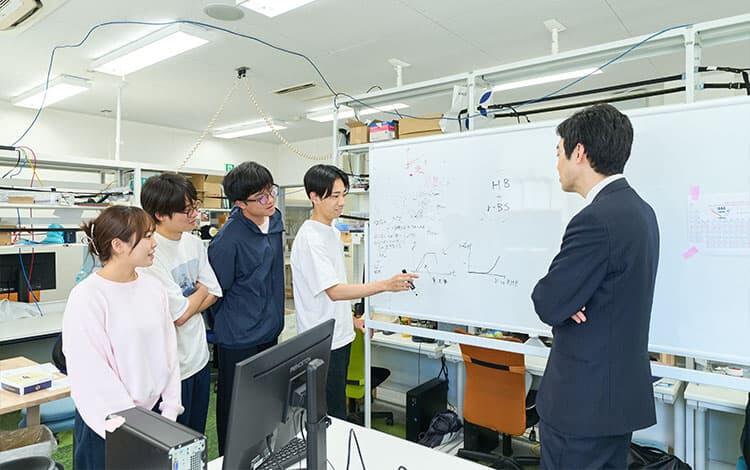
As the potential applications of HB continue to expand, the scope of our research is becoming increasingly diverse. Although securing sufficient experimental facilities remains a challenge, the nearly thirty students in our laboratory provide the energy and creativity that drive our work forward.
Discussions with students are among the most rewarding parts of my job. I always make time to talk with them about their research and future goals. I try to support each student as an individual, helping them build on their strengths while encouraging them to take on new challenges.
Boron itself is not widely known outside the research community. Nevertheless, when combined with other elements, it can exhibit remarkable and sometimes unexpected properties. Interestingly, my original research focus was not boron. I initially worked on carbon-based catalysts. Through collaborations and discussions with researchers from many different fields, however, I became interested in exploring new possibilities and eventually moved into boron research.
The development of HB has generated considerable interest from industry. Although the global research community in this field remains relatively small, collaborations with companies are steadily increasing, and pathways toward practical applications are beginning to emerge.
Our ultimate goal is simple: to develop useful materials that benefit society and help address today's global challenges.
Profile
(URL:https://www.ims.tsukuba.ac.jp/~kondo_lab/en/index.html)
Article by Science Communicator at the Bureau of Public Relations
TSUKUBA FRONTIER (PDF for printing)